Imagine with me: It was a cold and rainy morning as I observed a crowd gathering outside a stunning new building at 101 Independence Avenue SE, Washington, DC. November 1, 1897 was the long-awaited opening day for the new Library of Congress. Readers who had been regulars at the old Congressional Library in the Capitol Building arrived in horsedrawn buggies and on foot.
The Library guide cited the Library of Congress (LOC) “hosted books, architecture, sculpture, and paintings on a scale unsurpassed in any American public building.” The doors opened promptly and 9 a.m. There were no formal program or speeches.
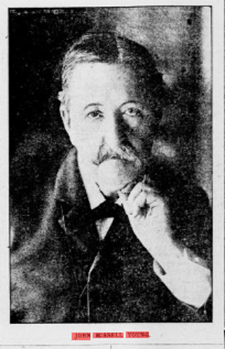
At the time, the US President was President William McKinley (inaugurated March 4, 1897) and VP Garret Hobart. The LOC Staff were: Librarian: John Russell Young (1841-1899), Assistant Librarian: Ainsworth Spofford, Superintendent of the Reading Room: Hutcheson, Superintendent: Green.
John Russell Young had been appointed by the President on July 1st of that year. Perhaps he didn’t have time to plan a “program” for the day. The Times newspaper noted that heavy rains that day couldn’t keep an enthusiastic crowd from witnessing the building, seated across the street from the U.S. Capitol, in person.
Of the 108 staff members, only a few are visible—the librarian at the central circulation desk and several runners collecting books from the stack delivery system. Most of the book movement happens out of sight on a specially designed conveyor belt.
There are reserved seats for members of congress as well as superbly lighted, decorated rooms. This is one of the first buildings to have electric lights. Books and books have been written recording the statues and paintings in the facilities. That will be for another story.
On opening day, old regulars filled the reading room with an exhilarating silence as they enjoyed what the new library had to offer. Signs on the wall reminded visitors this is a “quiet research place.”
A new Congressional Library catalogue from the Government Printing Office guided researchers. To borrow a book, visitors first had to fill out and sign a slip called a “reader’s ticket,” with the title and author of the book they wanted. Once the slip was filled out, it was sent through a series of pneumatic tubes in the library which connected to various stacks and floors of books, where attendants would pull the book and send it down to the reading room floor within approximately five minutes. The book carrying apparatus installed throughout the library involved pneumatic tubes which ran all the way to the Capitol building. [The Evening Star. 1897. “Library Now Ready,” November 1, 1897.]
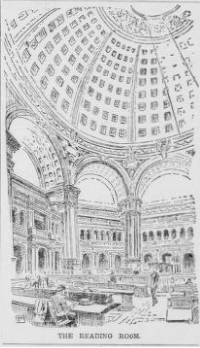
[The Times (Washington [D.C.]), November 2, 1897, p.1]
WHY THIS EVENT? Fast forward to 2025
During my visit to Washington D.C. last May I was able to visit the Library of Congress. It was a dream I had always had. My grandmother, who taught me genealogy, visited there in the 1970’s. Grandmother told me of the vast collections and she looked at as many books as she could during her visit. I requested just one book – the book that mom and I wrote about the Linse Schlagel Family in 1984. (Yes, I looked at it and it doesn’t show a lot of wear, but it is exciting to know it is there.)
Currently the LOC has 1.5 million visit per year, thousands each day. That’s 880,000 visitors at the Jefferson Building specifically. During the spring and early summer, the number of visitors to the building average nearly 2,000 per day; during the later summer about 800, and in the autumn about 1,200.
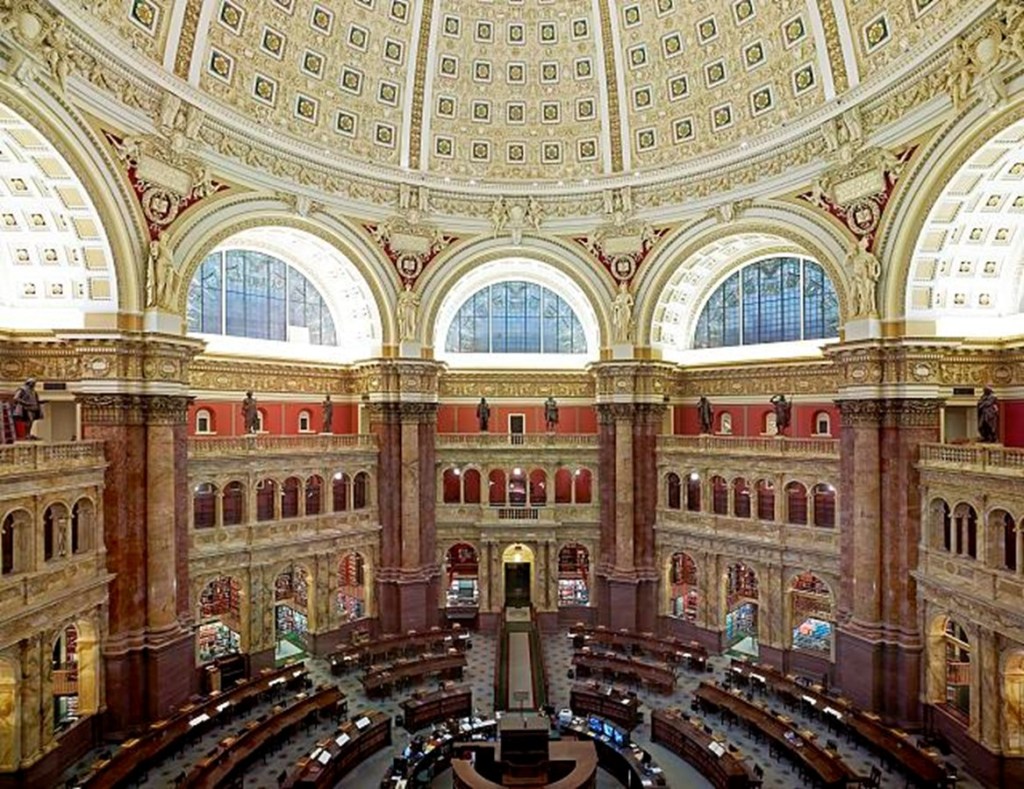
Hard to imagine that the building measuring 470 feet long north to south and 340 feet deep from east to west can now fill to capacity with visitors requiring a ticket holding your space to visit.
When I visited in May of 2025, they were open 10 am to 5 pm with extended hours until 8 pm on Thursdays. There was no line or required ticket for me to enter. During busy times you may need a free timed-entry ticket.
I did get a library card (you can order one online). You can utilize many digital items online! Newspapers, Civil War pictures, music, etc., etc. Note many of the newspaper files, dating back 250 years are available online in the Chronicling America. www.loc.gov
The online website generates 149.3 million visits and 505.3 m page views a year. 774,000 reference requests from Congress, the public and other federal agencies. They host more than 22.2 m copies of braille, audio and large print items. 424.2 k copyright registrations. 68.8 k reader cards, 26 m cataloged books, 5.9 m maps, 8.3 m items of sheet music, 1.9 m moving images, 15.9 m photographs. The current annual budget is 897,749,000.
Fun Facts:
The first Congressional Library began in 1800. Designed to record the business of the Congress and provide a research library.
They now have four LOC locations. Thomas Jefferson Building, John Adams Building, James Madison Memorial Building, Packard Campus for Audio-Visual Conservation.
The 1930 Handbook of the New Library of Congress stated they have 150 miles of book stacks.
It wasn’t until 1980 that it was named the Thomas Jefferson Building.
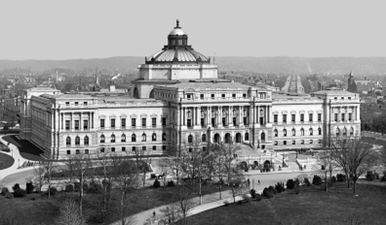
Library of Congress Building
TIMELINE:
April 24, 1800 – President John Adams approves an act of Congress that moves the government from Philadelphia to the new capital city of Washington. Five thousand dollars is appropriated for the purchase of books to be housed in the Capitol.
January 26, 1802 – President Thomas Jefferson approves a compromise act of Congress which states that the President of the United States will appoint the Librarian of Congress.
1812 – The first classified Library catalog is published. It lists 3,076 volumes, and 53 maps, charts, and plans. An adjustment in the Library’s rules exempts members of Congress from overdue fines.
August 24, 1814 – In retaliation for the capture of York and the burning of its parliamentary building by American forces, the British capture Washington and burn the Capitol, destroying the Library of Congress.
January 26, 1815 – The House of Representatives approves the purchase of Jefferson’s 6,487-volume personal library for $23,950 to replace the collection lost in the fire.
December 24, 1851 – An accidental fire in the Library on Christmas Eve destroys approximately 35,000 volumes, including nearly two-thirds of Jefferson’s library.
August 23, 1853 – Designed by Architect of the Capitol Thomas U. Walter, a newly remodeled fireproof iron room for the Library opens in the Capitol’s west front. It is widely admired and becomes a tourist attraction.
July 8, 1870 – President Ulysses S. Grant approves an act of Congress that centralizes all U.S. copyright registration and deposit activities at the Library of Congress.
December 1, 1871 – Librarian Ainsworth Rand Spofford informs Congress that the rapid flow of copyright -deposits into the Library’s rooms in the Capitol will soon necessitate a separate Library building.
November 1, 1897 – After years of overcrowding in the Capitol, the monumental new Library building officially opens to the public. It required about sixty days to move 750,000 volumes of books from the old to the new Congressional library.
October 28, 1901 – The Library announces that its printed catalog cards are now available for sale to libraries around the world.
March 9, 1903 – President Theodore Roosevelt issues an executive order directing the transfer of the records of the Continental Congress and the personal papers of George Washington, Thomas Jefferson, Alexander Hamilton, James Madison, James Monroe, and Benjamin Franklin from the State Department to the Library.
September 29, 1921 – President Warren G. Harding issues an executive order that transfers the original copies of the Declaration of Independence and U.S. Constitution to the Library for their safekeeping and display. The two documents are sent to their permanent home in the National Archives in 1952.
July 3, 1930 – $1.5 million is appropriated for the purchase of the Vollbehr collection of incunabula, which includes the first Gutenberg Bible in the Western Hemisphere.
March 3, 1931 – The Pratt-Smoot Act enables the Library to provide books for the use of adult blind readers of the United States and its territories.
August 2, 1946 – The Legislative Reorganization Act of 1946 is approved, giving the Library’s Legislative Reference Service (LRS) permanent status as a separate Library department and providing for the hiring of nationally eminent specialists in 19 broad subject fields.
April 24, 1950 – The Library celebrates its sesquicentennial.
September 13, 1954 – The Library receives the Brady-Handy photographic collection, containing more than 3,000 negatives made by Civil War photographer Mathew B. Brady and several thousand by his nephew Levin C. Handy.
March 27, 1969 – With the mailing of the first computer tapes containing cataloging data, the Machine-Readable Cataloging (MARC) Distribution Service is inaugurated.
May 28, 1980 – The third major Library building on Capitol Hill, the James Madison Memorial Building, opens to the public.
June 10, 1980 – The Library announces that the original 1897 Library building has been renamed the Thomas Jefferson Building and its second building, opened in 1939, is now the John Adams Building.
January 1, 1981 – The filing of cards into the Library’s main card catalog stops, and the online cataloging of the Library’s collections officially begins.
June 22, 1994 – The Library debuts its website at the American Library Association annual conference in Miami, Florida.
October 13, 1994 – The Library launches its National Digital Library program aimed at digitizing primary sources related to the study of American history.
October 5, 1999 – Metromedia president John W. Kluge donates $60 million to establish the John W. Kluge Center for Scholars and Prize in the Human Sciences. It is the largest private monetary gift in the Library’s history.
April 24, 2000 – The Library celebrates its Bicentennial.
July 26, 2007 – The new Packard Campus for Audio-Visual Conservation located on a 45-acre site in Culpeper, Virginia, is transferred to the Library by the Packard Humanities Institute. The Institute provided $155 million for the design and construction of the four-building facility, the largest private gift ever made to the Library.
September 14, 2016 – Carla D. Hayden is sworn in as the 14th Librarian of Congress. At the time of her swearing in, the Library’s collection of more than 162 million items includes more than 38 million cataloged books and other print materials in more than 470 languages; more than 70 million manuscripts; the largest rare book collection in North America; and the world’s largest collections of legal materials, films, maps, sheet music, and sound recordings. In fiscal year 2016, the Library employed 3,149 staff members and operated with a total 2016 appropriation of $642.04 million, including the authorization to spend $43.13 million in receipts.
 Geneographer