Since I was a child I have enjoyed research and writing the legacy of family history. From long chats with my grandparents to visits to the library I have loved the hunt for facts and information. Maybe it was the World Book Encyclopedia that my parents bought for us at home – we never guessed, we always looked it up!
Welcome to People Story Blog. I am interested in history, the history of anyone, anytime, anyplace, really the history of anything.
Subscribe below to get notified when I post new updates.
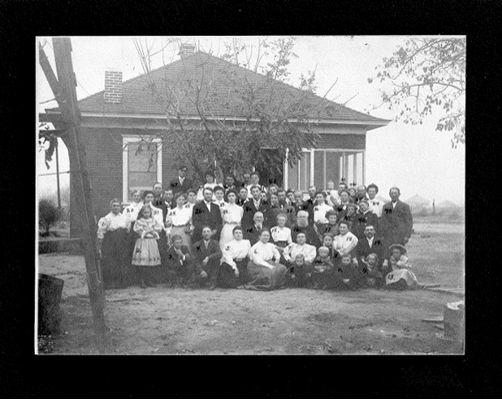
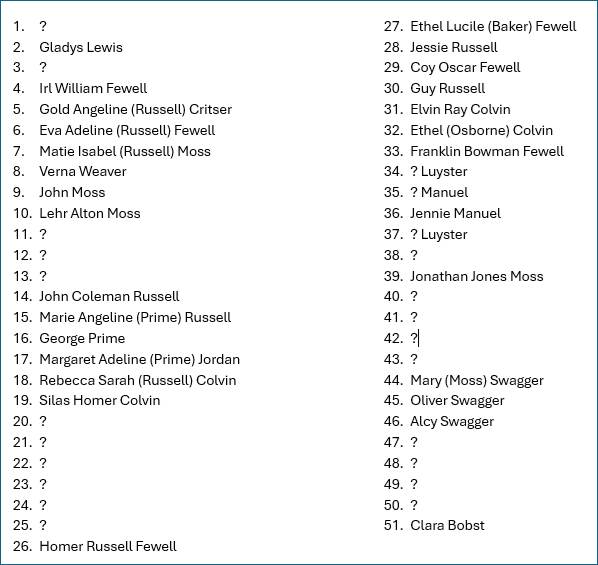
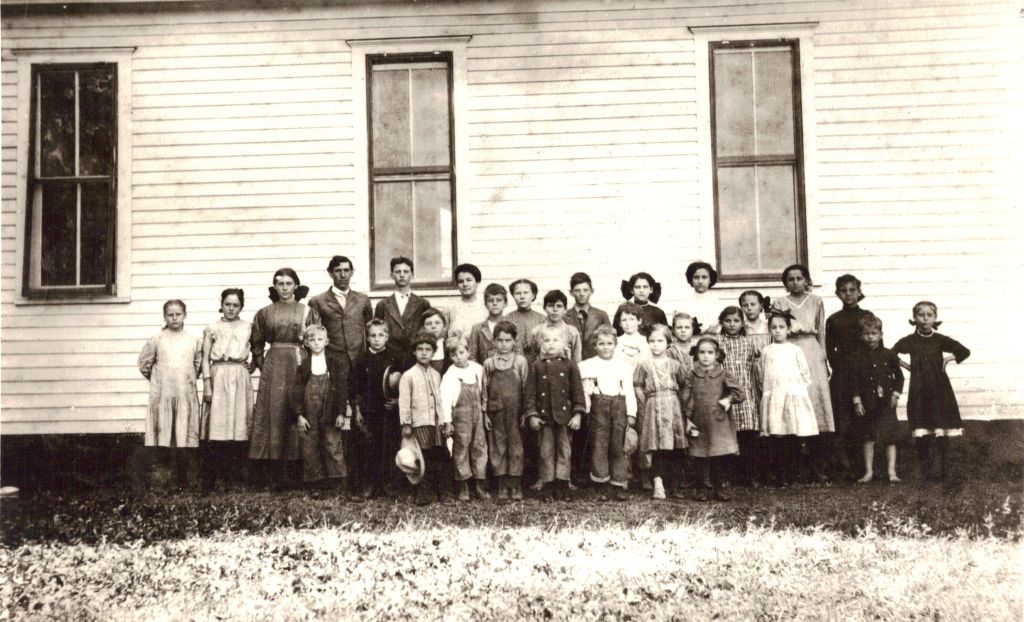
1909 Taberville School Taberville, St Clair, Missouri
The 1909 Taberville School photo has no names listed and so the search begins.
I utilized the 1910 United States Census for the state of Missouri. The census reveals the names of children who lived in the Taberville Township of St Clair, MO. They may have attended this school. I sorted them by age and approximate birth year.
From the 1910 census “attending school”
*Also in the 1911 photo
The search-story: The photos were found on an old rootsweb site about St Clair County, Missouri schools. Shared by Dave Davidson, it stated that Alfred C. Davidson II is in the front row far left, holding a hat. His father was a local Physician.
Looking up each name up online has yielded some clues including marriage records for some, census records and obituaries (more about that next time).
The Appleton City Journal and the Appleton City Tribune newspapers have given me clues about the teachers at Taberville School. In April 1905 Mr. John Henry Aldridge was teaching. On 03 Jul 1907 he married Miss Mary Lou Heath. Sep 1908 another mention and again in Apr 1909 and Sep 1910.
And that is how a nameless picture of children becomes more than girls in dresses and boys in overalls.
Now I hope other searchers will see this and fill in the pieces. Do you see your family member in this picture?
1911 Taberville School
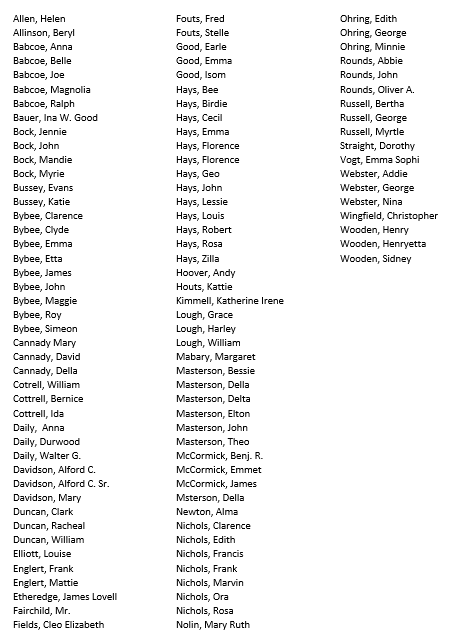
Index of names (children and parents) who may have attended.
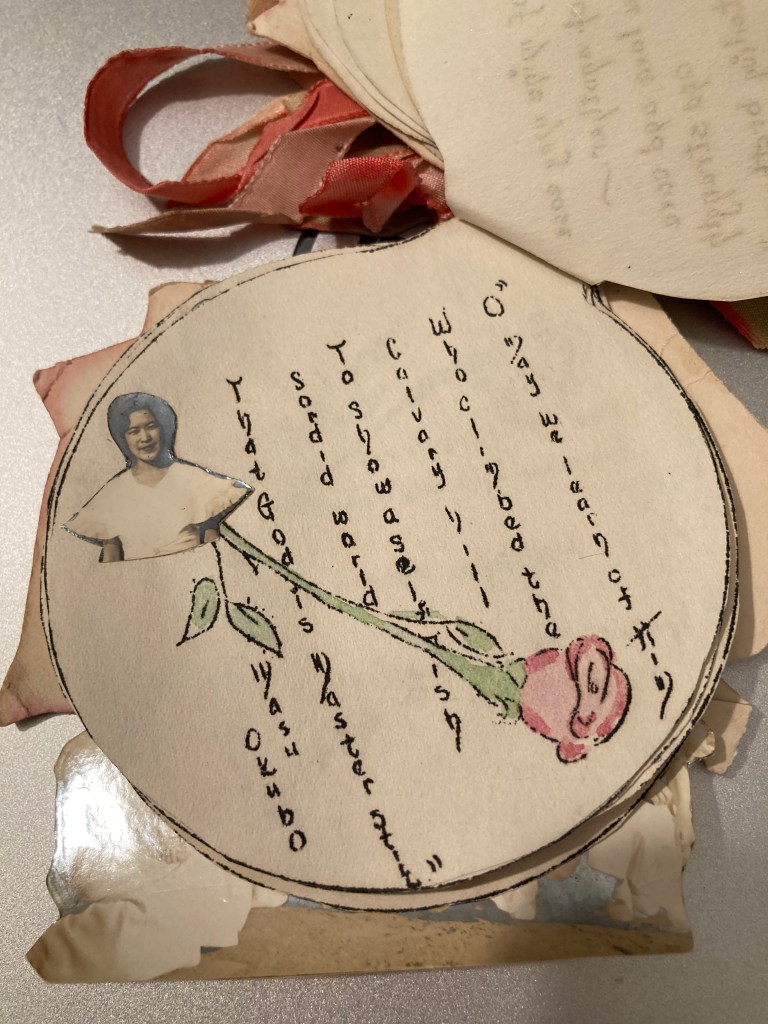
I found a small paper scrapbook in my grandmother’s belongings after she passed. I didn’t recognize any of the names, it wasn’t my family, so I wondered what to do with it? It was hand-made, very delicate, about 4 inches by 4 inches. The cover was flower shaped on thin, hand-colored paper. Tied with ribbon, each page had a photograph of a young woman along with her signature and a poem.
But where should I file it? None of the names were in my family tree. I wondered had my grandmother picked it up along her life path? Was it her friend? Did she think it was pretty? If it was my family and someone else had it, I would have loved to find it. So I began looking at the names.
The names in the booklet are: Rosalia Anderson Dorothy Bodwan Eleanor Codwallader Eleanor Clay Ida Mary Davis Anise Doup or Houp Helen Hamilton Josephine Lambert Harriet Denkar Masu Okubo Alice Pierpoint Mae Howell Winifred Sutton Evelyn Swenson Marion Totty
The hand cut photos added to its uniqueness. It was clearly a treasure! Thanks to the internet I did a search online for a connection to any name in the book. One unique name revealed a match on Ancestry. I sent a message and got a quick reply back. Yes, it was her grandmother’s sister. After a flurry of emails, I sent her the digital copies of the booklet, yes it was indeed her family member. The Methodist Training school at San Francisco was also referred to as the National Training School. It was a 2 year Methodist college back then. 1932-33.
She sent me photos of her grandmother’s sister, Masu Okubo, wearing the same dress as in this picture. Names were written on the back and we agreed this was the same person.
I sent the precious scrapbook to their family. They were very, very thankful.
What are you thankful for in your family history research?
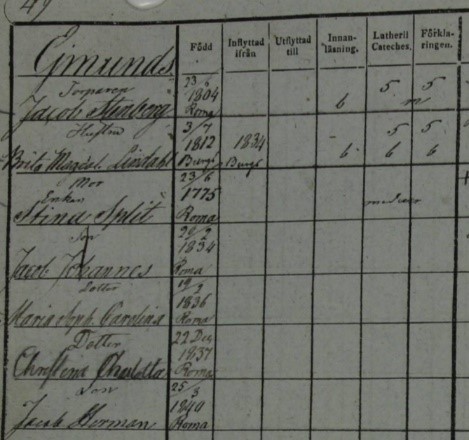
Stina Split. I remember the name clearly. I was a very young, inexperienced searcher eager with anticipation as a library assistant helped me find the microfilm index and I ordered a film of Swedish Clerical Survey Records.
Researching my maternal line, I found the surname APPLEQUIST to be very interesting. It was easy to read in original Swedish records and thanks to the book Cradled in Sweden by Carl-Erik Johanson, I found Swedish research to be “very rewarding.” Beginners luck.
I knew my immigrant Great Great Grandfather to be Johan Peter Herman Applequist. He was born in 1860 at Visby, Sweden. From the microfilm I learned that his father Nils Peter had a wife named Christina Magdalena ‘Charlotta’ Stenberg who had a father named Jacob Stenberg. I followed them page by page from the 1860’s back to a Clerical Survey Record listing for Stina Split born 1775.
I was in awe finding the first member of my family with a birthdate BEFORE 1800. I marveled that I had connected to ancestors, in foreign countries, living during the 18th century. This forever changed history class for me as I am now inserting my own family names into the history of the world.
Today I sit in my recliner and look at the Clerical Surveys from my laptop and much more! I doubt there will ever be a book with Stina Split’s name in it (until I write it). But I can easily picture what farm life was like in rural Sweden, thanks to information found online.
The village Stina Split lived in was Romakloster, even now it has only 936 inhabitants. Featuring good land, fertile in pasture and grain, abounding in timber. It is located on the island of Gotland, the largest island in Sweden, centrally located in the Baltic Sea about 90 miles from the mainland. Today there are about 58,000 inhabitants on the entire island.
Just think in 1775 when Stina was born the Revolutionary War was breaking out in US. Captain Cook hadn’t even discovered Hawaii. Handel’s Messiah was brand new and the Waltz was becoming fashionable in Vienna. Sweden was ruled by King Gustav III. The population of the country of Sweden was 2,020,847 and there were 71,641 live births.
Recent research reveals Stina Split was born as Christina Stephansdotter. Parents: Stephan Pehrsson (1739-1823) & Ingrid Larsdotter (1746-1791). She married Jacob Jacobsson Dansare Split on 25 Apr 1805 at Roma. He was son of Jacob Jacobsson Bander (1746-1810) & Sophia Persdotter (1750-) It appears the family had lived in Roma since before 1695. Sweden was established in 1164.
Stina Split died at age 70 on 15 Mar 1846 at Roma. Amazing when you think of all the maladies and disease of the time: fevers, smallpox, dysentery (called rödsot or blodsot in the Clerical Record). Life Expectancy for women at that time was 37-54 years old.
Stina Split’s children include son Jacob Stenberg (04 Dec 1804-11 Feb 1872) *my line and daughter Anna Sophia Engstrom (23 Apr 1807-). Jacob was a Torpare (small farmer).
While I am still waiting to connect my lines to the “Adams Genealogy Chart” that my Oma gave me for my 16th birthday, I am on my way.
Who is your oldest ancestor?
Gotland Island Sweden
Sweden Household Examination Books 1806-1834 Ejmuns Inhyses, Roma, Gotlands, Gotland, Sweden. Stina Split born May 23, 1775
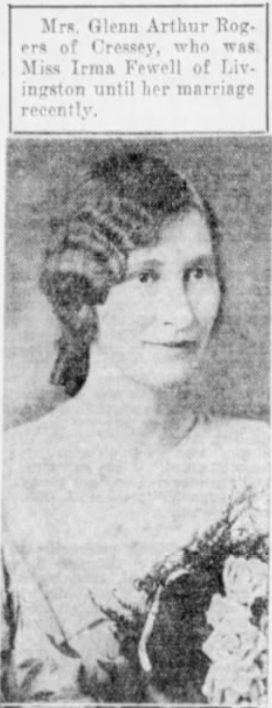
Mrs. Glenn A. Rogers, 1st grade teacher aka Irma Elizabeth (Fewell) Rogers
A 1988 Walla Walla Newspaper article about her stated “Mrs. Rogers called the photograph of a class of first-graders “my little treasures.” Teaching at Sharpstein School from 1951 to 1969 she estimates she taught nearly 600 pupils. To celebrate her 80th birthday her family encouraged former students to send a greeting and with a newspaper article, many responded!
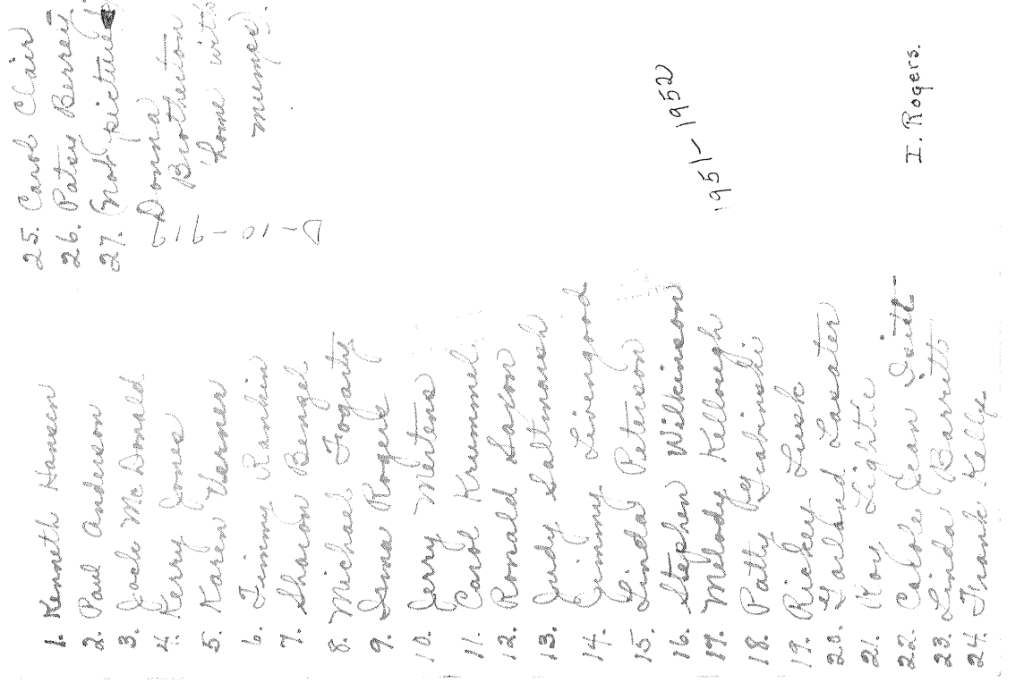
1951 – 52 Sharpstein School, First GradeHandwritten list of student names
1951-52 ANDERSON, PAUL BARRITT, LINDA BENZEL, SHARON BERREY, PATSY BROTHERTON, DONNA CLAIR, CAROL FOGARTY, MICHAEL GIABINSKI, PATTY HANSEN, KENNETH ISITT, CAROLE JEAN JONES, KERRY KELLOUGH, MELODY KELLY, FRANK KRUMMEL, CAROL LASATER, GARLAND LIGHTLE, ROY LIVENGOOD, JIMMY LUSK, RICKEY MCDONALD, JACK MERTENS, JERRY RANKIN, TIMMY SALTMARSH, JUDY SAXON, RONALD VERNER, KAREN WILKINSON, STEPHEN
Irma was born in 1908 to Coy & Ethel FEWELL at Turlock, Stanislaus, California. She had a brother Russell. She graduated from Livingston High School in 1925. She attended Lodi Academy and Normal School at Lodi, CA. She was inspired to be a teacher by her own first grade teacher Harriet Sanford whom she never forgot.
Her teaching career began in 1928 when she taught at Woodland School. She was 20 years old. Her first classroom hosted 16 children and covered “all grades.”
Her next position was at Turlock School. She taught in a 2 room school.
On 30 Aug 1931 she married Glenn Arthur Rogers at Turlock, Stanislaus, California. Irma was 23.
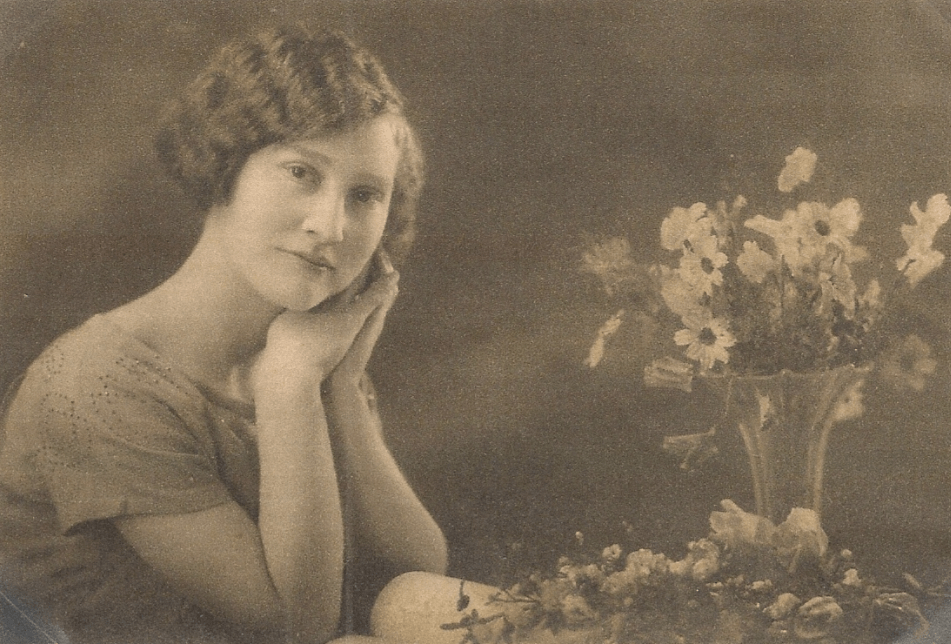
Irma (Fewell) Rogers
The Fresno Bee (Fresno, CA) 06 Sep 1931, Sun, p. 17.
In 1934 she lived in Cressey, CA and she turned her attention to motherhood when her children started school she resumed teaching. Teaching at Merced while also attended Pacific Union College at Angwin, CA, always learning.
In 1947 they moved to the Idaho and taught for the Caldwell school. Irma and Glenn taught there for 2 years.
1948 brought a move to Yakima, Washington where she taught grades 1-4 at Brookside School. Her husband, Glenn taught 5-8th grades.
In 1949 they moved to Walla Walla. She received her Masters’ Degree in Education, with a minor in Geology at Walla Walla College.
1951 began teaching at Sharpstein Elementary. A substitute at first but soon she was asked to take a First Grade Class. She continued there for 18 years. In 1969 she retired from Sharpstein Elementary.
After 44 years of teaching she received Letters of Appreciation from Del G. Peterson, Superintendent of Walla Walla Public Schools, Allen Reynolds, Asst. Superintendent and Peter P. Muirhead, Acting US Commissioner of Education.
At retirement she and her husband travelled extensively. Visiting many of the historical places she enjoyed every stop. At home she had a room she lovingly called the “Den.” It contained her family history books, supplies and a typewriter. Others were not welcome in her ‘Place’ without being invited. It was full of three ring binders, her genealogy correspondence and the Genealogy Helper Magazines which she had highlighted and made notes in.
She was a member and officer of the Colonial Dames. She was a member of Daughters of the American Revolution.
She died in 1992 but she continues to inspire my research. Were you a student in Mrs. Glenn Rogers’ class? Do you remember your first grade teacher?
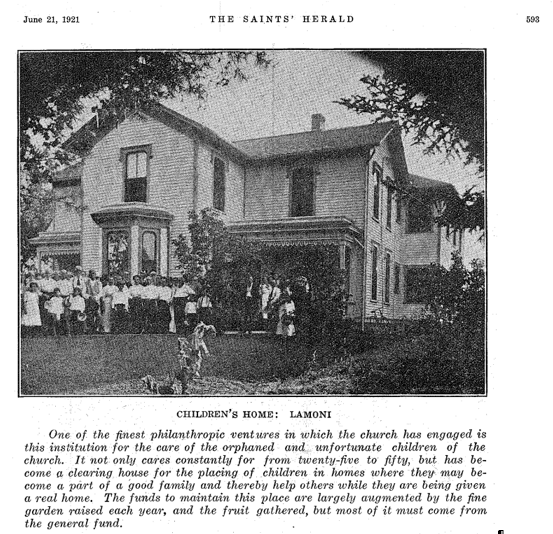
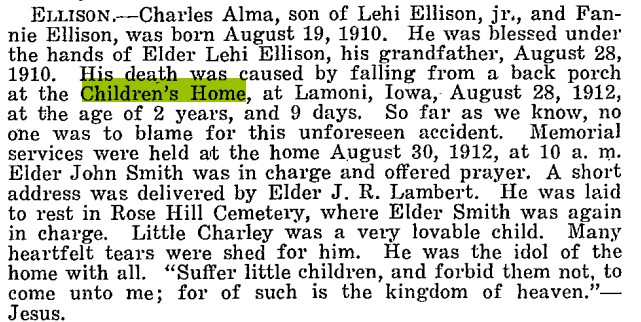
From 1911 to 1925 the Children’s Home at Lamoni, Iowa was home to 215 children. Whether a temporary stay or years of residence at the Home, it had a huge impact on all involved. Some of the children were returned their families, some adopted and some “aged out.”
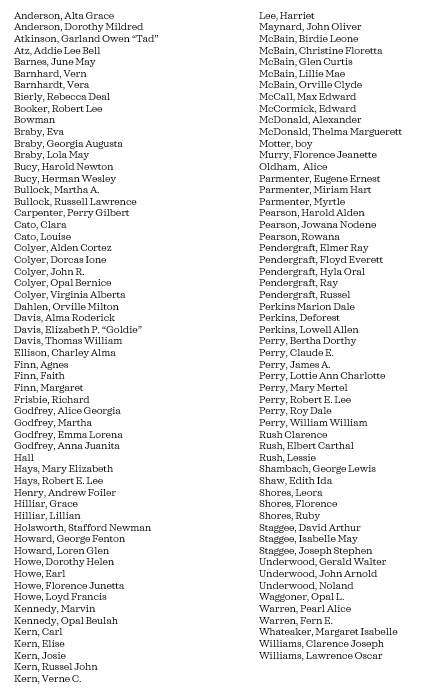
Here are the names of children that I have located from a variety of sources:
Through the years, there were 15-40 children at the Home at any time. A 1922 Lamoni Chronicle newspaper reported about a farm known as the “Home Farm,” it fed the Children’s Home, Saints’ Home and the Liberty Home. The 240 acres includes a large lake which furnishes the city water. Alfalfa, pasture land along with 26 acres of winter wheat, 25 acres in oats, 55 acres of corn, 30 acres in timothy and clover and 12 acres in orchard and gardens.
The dairy herd numbered 42 head of Holstein cattle, generating 455 pounds of milk or about 227 quarts per day. Alfalfa and corn are grown for feed. They make their own butter and the inmates are furnished with all the milk and cream they need.
155 Duroc Jersey hogs of which 40 brood sows are kept for breeding purposes. A flock of 800 chickens, 340 hens being kept for winter layers. A variety of vegetables supply the three homes year round. [21 Sep 1922 The Lamoni Chronicle (Lamoni, IA) Thursday, September 21, 1922]
CLOSING OF THE HOME
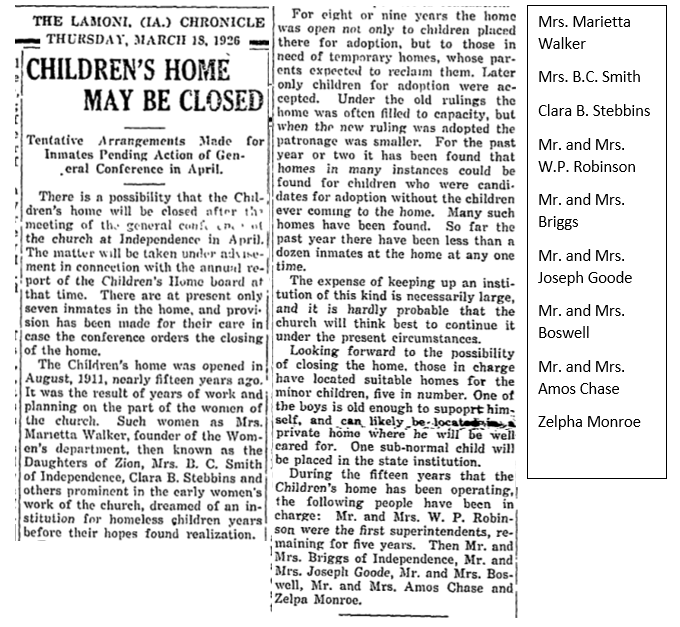
After 15 years of successful operation, a difficult decision was made to close the Children’s Home.
From the organizational inspiration of Sister Marietta Walker through the leadership of the last Matron, Zilpha Monroe about fifty families were cared for.
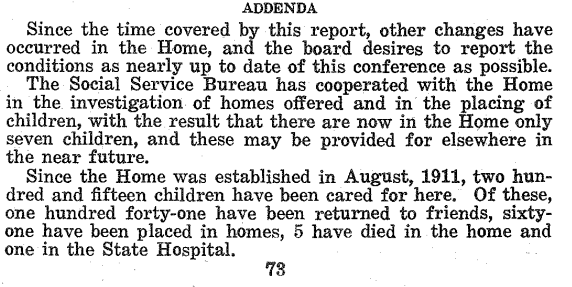
A summary from the Report of the Board of Trustees of the Saints’ Children’s Home for the year ending June 30, 1925 to the Seventy-First General Conference p. 104 summarizes the decision to close:
“Since the Home was established in August 1911, two hundred and fifteen children have been cared for here. Of these, one hundred forty-one have been returned to friends, sixty-one have been placed in homes, 5 have died in the home and one in the State Hospital.
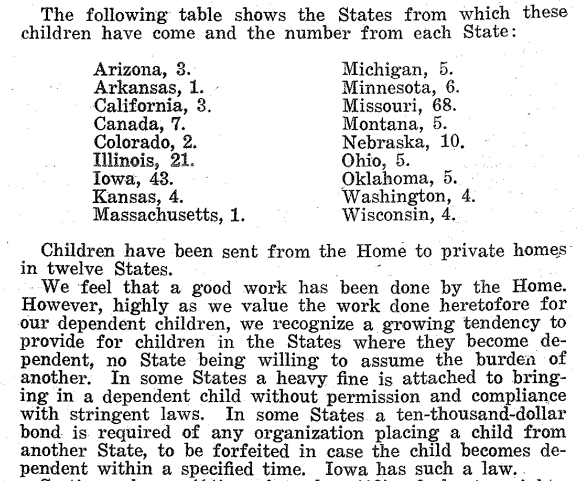
A state policy restricted children being brought into Iowa from other states for care.
We therefore, present for the consideration of the conference the advisability of discontinuing the Children’s Home the work of providing for the dependent children who come under the care of the church to be conducted by the Social Services Bureau. It was approved. 1925.”
[1926 Reports To The Seventy-First General Conference April 6, 1926 p. 73]
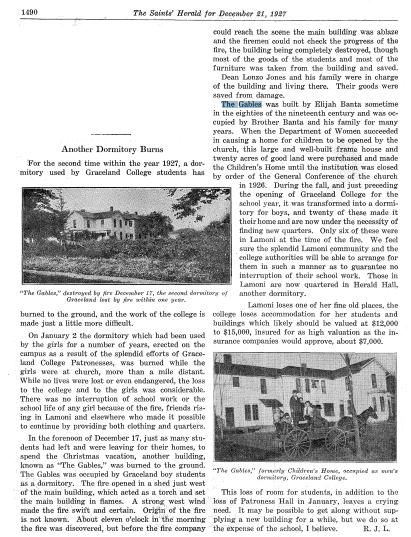
According to Graceland historian Enid DeBarthe “The Children’s Home discontinued operation in 1926 on recommendation of the Board of Trustees and with the approval of the Presidency, Twelve and Presiding Bishopric.” [Ch. Hist. Vol 8:76] The Home building was used by Graceland College as the Gables, it was destroyed by fire December 17, 1927.
As reported in the Saints’ Herald for December 21, 1927. P. 1490:
Imagine my delight to see this photo of the back of the Children’s Home with Children on the buggy! Must be early days of the Home, could it be my grandfather? [Saints’ Herald, December 21, 1927, p. 1490]
Why do these pictures and names matter? Because they are stories of life. Stories of people who by no fault of their own had parents who were unable to care for them. The Children of the Home grew up tough and scrappy. Facing adversity and adjusting to whatever life gave them.
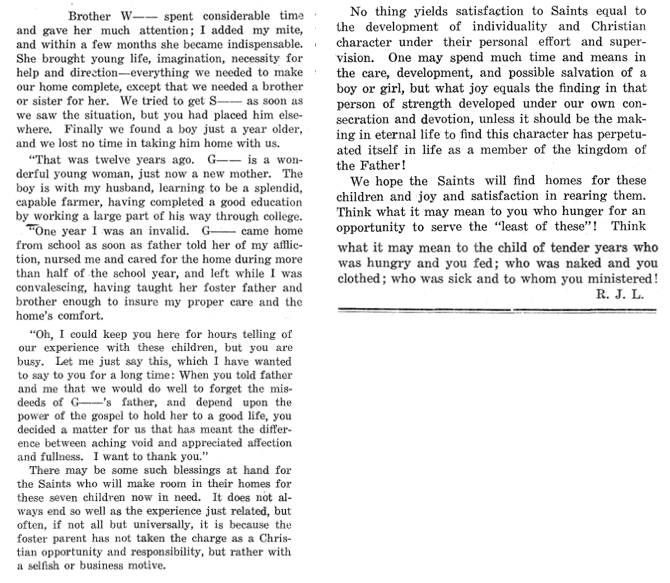
The following 1927 Saints’ Herald article reflected back on a positive adoption experience from the Home. It also emphasizes the “good work” accomplished by taking in a child into a members home.
[Nov 16, 1927 Saints’ Herald p. 1330]
A description in the 1926 Lamoni newspaper adds some insight about the decision to close.
SOURCES:
Autumn Leaves (Vision in 1929) 1888 – 1932
Biographical and Historical Record of Ringgold and Decatur Counties, Iowa: 1887. Chicago, IL: Lewis Publishing Co. Online at: FamilySearch Digital Library.
History of Decatur County, Iowa, and its people. 1915. J.M. Howell and C Smith Heman. Chicago, IL: J. S. Clarke Publishing Co. Vol I Online at: FamilySearch Digital Library, Vol I and II Online at: Ancestry — index and images
iagenweb.org/boards/decatur/biographies Decatur County Iowa
Iowa State Census 1905, 1915, 1925
Journal of History 1908 – 1925 Heman C. Smith editor
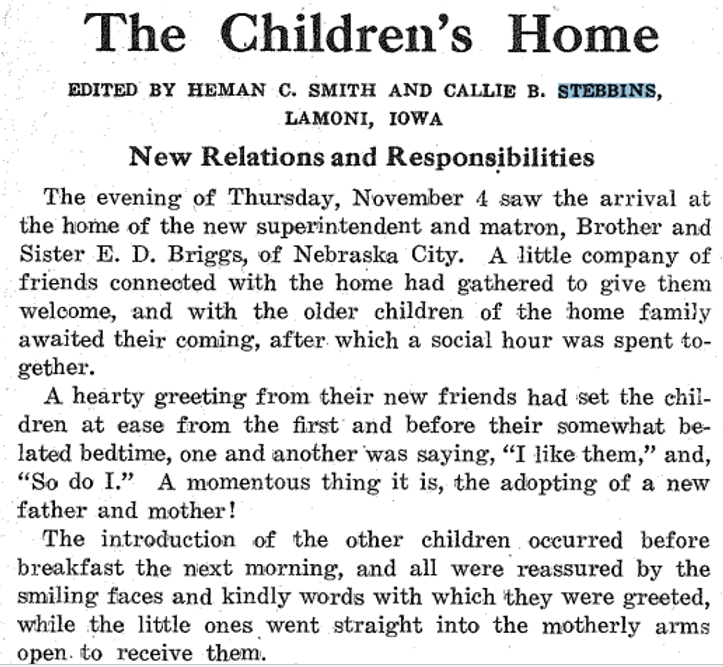
“It was a momentous thing, the adopting of a new father and mother at the Home”! This 1915 Saints’ Herald report gave us a good idea what a Day in the Life was like for the children with the arrival of Brother & Sister Briggs as the 2nd Managers of the Home.
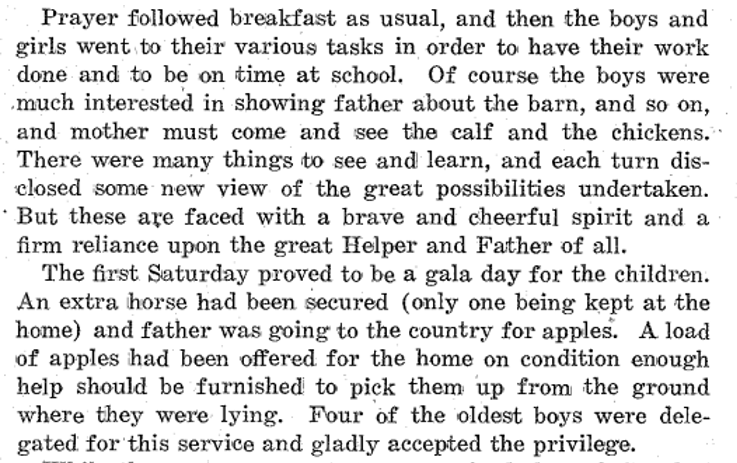
Early day descriptions of the Manager and Matron of the Children’s Home (W.P. and Isabelle Robinson) reflect that it was a loving, warm and kind place. But later reports indicate the reality was a less pleasant, more regimented daily life. Perhaps as the Home filled to capacity there were more chores, school work and attendance was required at required religious services.
Day to day life for the girls likely included washing dishes and sweeping. The boys did farm chores and hauled wood. Likely all children helped with the gardening. There were many references to proper discipline in all activities. This 1915 decision about the Home made it very clear they were rearing the children under the influence of the Reorganized Church of Jesus Christ of Latter Day Saints:
The Saints’ Herald, vol. 64 April 5, 1916 p. 338
In the 1920’s the Home had about 30-40 children at one time. For a Home this size there was much laundry to be done, food to prepare and socks to be darned. Bushels of vegetables were grown in the gardens and cows to be fed and milked. There were eggs to be gathered, butter to be churned and meals to prepare.
The February 12, 1925 Lamoni Chronicle reported that “two young girls at the Children’s Home. Margaret Finn and Opal Williams started on foot for Kansas City. They were brought back by Mr. A.J. Yarrington. The girls were good and tired as a result of their thirty mile hike. Children cared for in a splendid institution such as we have in our midst are too young to correctly evaluate their opportunities, but as they grow older they will learn to more fully appreciate what is done for them and the advantages in a way of a home, schooling, etc, which is offered them.” [12 Feb 1925 Lamoni Chronicle, (Lamoni, Iowa), Thursday, p. 1]
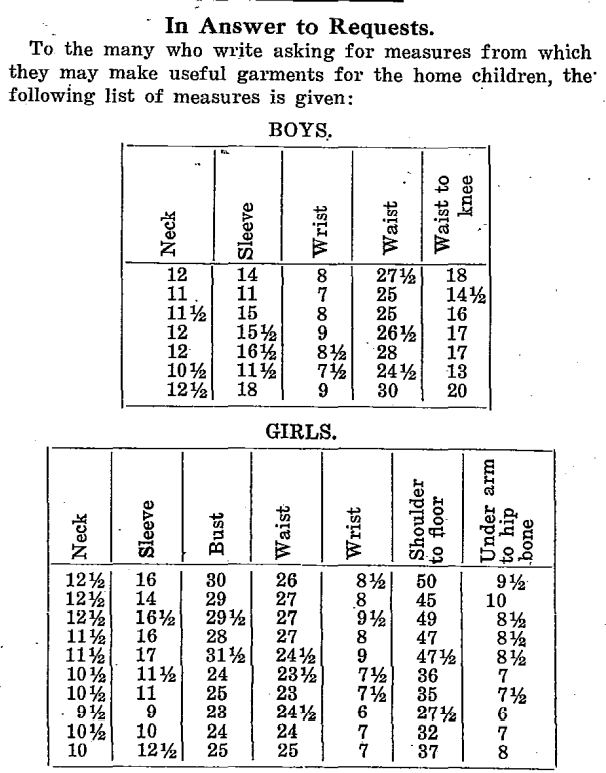
Often the Saints’ Herald and Zion’s Ensign reported the ages and sizes of children at the Home so that members could sew clothing for them.
The list contains 7 boys and 10 girls. [The Saints’ Herald, 6 Dec 1911, p 1168]
Appreciation for donations was posted in the publications by name such as this 1913 report. Noting donations of everything from clothes to candy.
[The Saints’ Herald, March 26, 1913 p. 313]
From the 1915 Home photo it does look like the children were dressed nicely and the girls each had their own doll, likely made and donated by rLDS church members. Much support came from local churches all over the U.S. and Canada. Each monthly magazine included appreciation for the donations of money and items. Everything from caps, gloves, dresses, sweaters, cotton stockings, neckties and quilts. One of the donations was from Cecil Hays Rounds who sent “$2.25 for shoes for brother” That brother was Robert Hays who lived at the Lamoni Children’s Home from 1911-1915.
The Reorganized Latter Day Saints were a close-knit church family. Celebrating religious services and regional camp meeting gatherings. It appears the Home children were required to attend services at the nearby church. Records indicate the children were baptized at the Home, if they had not previously done so. I found these baptisms: Murray, Florence Nov 15, 1913 Perry, Robert E. Lee Jun 14, 1914 Perry, James Jun 14, 1914 Perry, William Jun 14, 1914 McCormich, Edward May 12, 1918 Pendergraft, Floyd Mar 2, 1919 Bucy, Harold Newton Mar 2, 1919 Pendergraft, Hyla Oral Jul 3, 1920 Underwood, Gerald Jul 3, 1920 Bucy, Herman Wesley Jul 3, 1920 Howe, Dorothy Helen Jul 3, 1920 Kennedy, Opal Beulah Jul 3, 1920 Schambach, George Jun 26, 1921 Braby, Eva July 2, 1925 Howard, George July 2, 1925 Howard, Loren July 2, 1925
The Lamoni Chronicle newspaper reported the baptisms including 3 of the inmates of the Home George and Loren Howard, Dorothy Turpin.
Children’s Home residents likely attended the Central Lamoni School. In the 1920’s they attended the East Side School, sometimes the West Side School. I hope to discover more about the school situation.
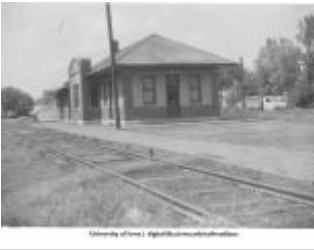
In the early days of the Home, children likely arrived by train as the roads were not yet paved and few had access to cars. This is a picture of the lonely Lamoni train station (established 1910) where the children may have arrived and departed.
There were 4 passenger trains daily on the CB&Q. 17 Aug 1911 The Lamoni Chronicle (Lamoni, IA) p1
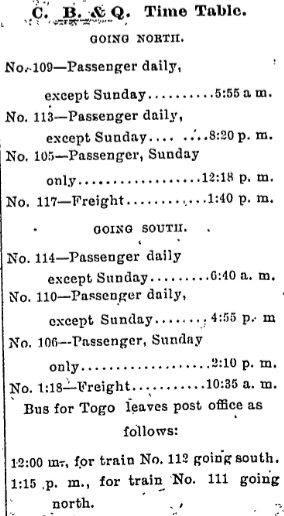
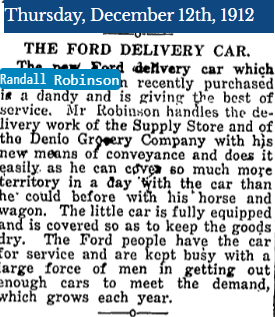
Times were changing rapidly and as the automobile gained popularity the train schedule became less and less useful. By 1913 there were several cars in Lamoni including W.A. Grenawalt. Randall Robinson also owned a car as noted in the newspaper. (Randall is the son of Superintendent Robinson.)
Recently I emailed with a woman whose mother was a child in the Home in the 1920s. She described a dismal situation. According to her there was limited food, hard work and hard discipline. She stated “they were required to attend church and other religious meetings. The discipline was so severe they left the home and the church too.”
I’ll end with some positive thoughts, hoping that sometimes the children had fun, I imagine they played hide and seek in the big yard, slid down the banister and jumped rope. I bet the boys would tease the girls and climbed trees maybe even sneaking food from the kitchen. There were 4th of July picnics, the county fair, Christmas celebrations and Easter egg hunts.
A 1925 report to the General Conference on the Children’s Home:
[May 6, 1925, Minutes of General Conference 1925]
This research all started because I wanted to learn more about my own family’s heritage and it has turned into an effort to learn all I can about ALL the children at the Home in Lamoni. This Home was not necessarily an orphanage, often one of their parents were living but could not care for them. Many children arrived as “temporary care” although some were adopted.
Recently I stumbled onto the podcast regarding the Lutheran Home at Muscatine, Iowa. https://thehomes.buzzsprout.com/1847793 Produced by Andrew Newell and Karen Thalacker their day to day accounts of life at their children’s home is wonderful. As I listened to the podcast “The Homes” I was touched by their introduction describing “ordinary folks doing extraordinary things.”
In 1929 their Superintendent Rev. Kline wrote “When we are gone and forgotten our buildings will keep on proclaiming that here have lived people who had a heart for the needs of children.” Their podcast skillfully depicts that even though the buildings are gone, they have uncovered the long forgotten stories of the people who lived there, worked there and died there. They were at the same time ordinary and extraordinary. The Muscatine Home used the word “half-orphans” – meaning they might have had one parent, but they were unable to care for them. In the early days, there were no government programs to help and the churches did their best to provided help to families before Federal Programs took over.
Often the children left the Lamoni Home with nothing but their memories but sometimes they left with adoptive families who filled their life with love. For most they left and never looked back.
The names of Lamoni Children’s Home residents have been found through a variety of ways. Census (see last blog), 1. church publications, 2. newspapers, 3. cemeteries and 4. court records. Recreating a list of all children who spent time at the Home has become a goal.
1. Church publications: through the years several Reorganized Latter Day Saints’ church publications had regular reports from the Children’s Home. Publications include Autumn Leaves, Reports to the General Conference, Journal of History and The Saints’ Herald.
Letter to Saints’ Herald April 7, 1915 p. 345 “I am thankful for the provisions we have in the church, for the poor; the Children’s Home, the college, the homes for the aged, and the Sanitarium, all to help and bless the people of God. I was the cook in the Children’s Home for a time, and if there are any who are in doubt about the home, let them lay all fears aside and do all in their power to help those who are so bravely carrying on the work. The children had good care, and were seemingly very happy there, with loving counsel and advice given by Father and Mother Robinson. While there we were all made sad by the unfortunate accident that caused the first death, and left the home without Baby Charles. I will never forget the beautiful Gospel talk Brother Robinson gave those children about that lovely country where baby had gone and how they should live in order to meet him. I thought, how good that those children could have such a kind father, for I knew there are many homes that do not have such teachings.” Mrs. William Case Dowker
It is reports such as this that hold so much information about how many Inmates were at the Home:
Saints’ Herald v 62, April 14, 1915, p. 368 “The children of the Home of school age have attended school in the public schools of Lamoni. Since the home was started there have been 33 applications for children. Twelve have been placed in homes, and 3 of these have been returned. The number of children in the home on this date is 22; 11 girls and 11 boys, ages 2 years to 17 years.”
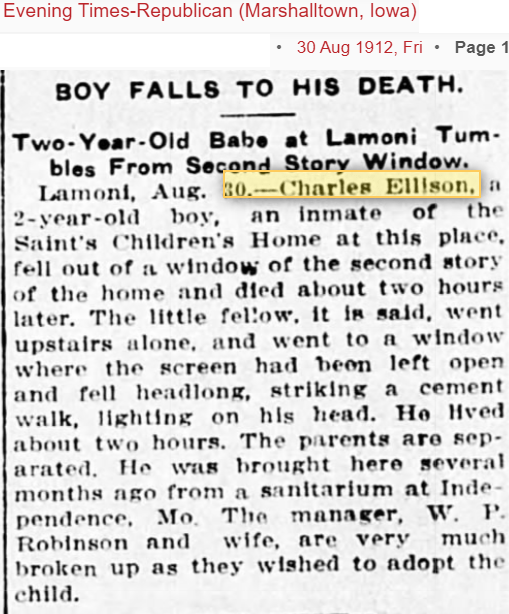
2. Newspapers provided some clues, such as the tragic death of Charles Ellison:
The tragic news spread quickly.
30 Aug 1912 Charles Ellison, a two-year-old boy, an inmate of the Saint’s Children’s home at this place, fell out of a window of a second story of the home and died about two hours later. [Quad-City Times (Davenport, IA) and The Gazette (Cedar Rapids, IA)] The parents are separated He was brought here several months ago from a sanitarium at Independence, MO. The Robinsons wished to adopt the child. [Evening Times-Republican (Marshall, IA), p. 1]
There must have been gasps and screams when the Superintendent, Matron and other children realized that Baby Charles fell from the window as reported in the Lamoni Chronicle.
The Saints’ Herald reported Charles Ellison was laid to rest in Rose Hill Cemetery.
[The Saints’ Herald, 11 Sep 1912 p. 890]
The death of Baby Charles Ellison became regional news.
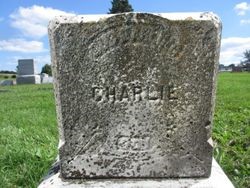
3. Cemeteries provide clues also.
Here is the grave of Charlie Alma Ellison at the Rose Hill Cemetery, Lamoni, Iowa. On Findagrave.com indexed as Charley Alma Ellison 19 Aug 1910 – 28 Aug 1912. Plot 699, Grave 1 Memorial ID 163507188.
Another child died while at the Children’s Home. Bertha Dortha Perry died on 07 Mar 1914 and is buried at Rose Hill Cemetery. Bertha Dorothy Perry was born 24 May 1909. Memorial ID 144324640.
The Saints’ Herald posted the following obituary for Bertha Dortha Perry.
[March 18, 1914 The Saints’ Herald, p. 262]
Another news making story was that of Josephine Morgan of Sedalia, MO who left her infant child at Children’s Home in May of 1912. Mrs. Mabel Gaulter Page and her daughter Mrs. Blanche Vaughn ended up in jail after attempts to take child from Children’s Home. The girl is Jessie Gaulter, 10 years old.
There were many reports of the trial, witnesses and reports of this case. Nearby Leon Journal-Reporter included the fact that the child was at the Children’s Home.
4. Court Records
Another research source is Decatur County District Court. This example is the Iowa U.S., Wills and Probate Records 1758-1997. Decatur, Probate Card Files 1873-1926, Box 103-Box 107. This file describes that Jessie is a minor subject to guardianship, and whose father has no legal custody and is not within this State. Also whose Mother has no legal right to guardianship and is an unfit person to have the care and custody of said child, and is not a resident of the State of Iowa. That said applicant is a sister of said minor Jessie M. Gaulter. The papers go on to say: Jessie M. Page is now in the Children’s Home at Lamoni, Iowa and is being cared for by said Home. The case was dropped and the family returned home.
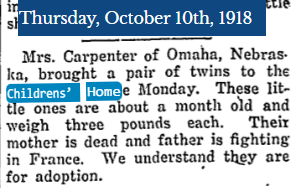
A 1913 report in the Lamoni Chronicle told of a pair of twins arriving at the Home due to death of mother and the father is fighting in France.
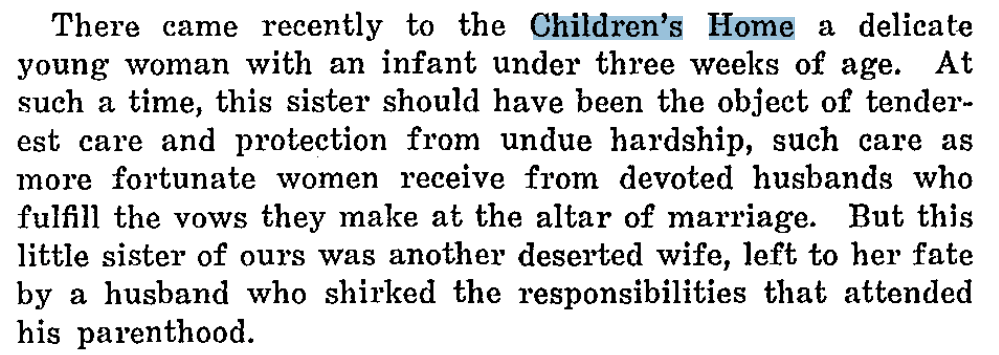
The following story tells of a young woman from undue hardship arriving with an infant. [The Saints’ Herald, June 4, 1913, vol 60, p. 553]
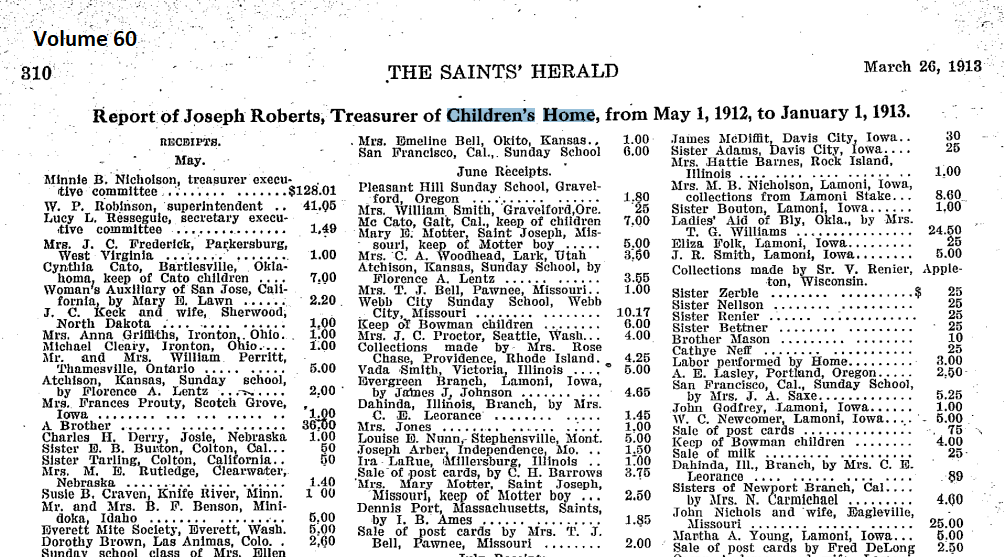
These stories represent the sometimes-difficult, heart-breaking situations that children experienced. The Church papers often report the good work of Home and constant call for donations and support were called for. Below is an example of the 1913 Bishop’s Report regarding support of the Children’s Home. First is donations received such as candy, clothing and hankerchiefs.
Secondly, in the same report of financial donations I gleaned even more names of children: Keep of Cato children, Hall children, Motter boy and Bowman children. Report of Joseph Roberts, Treasurer of Children’s Home, from May 1, 1912 to January 1, 1913.
[The Saints’ Herald, March 26, 1913, Vol. 60 p. 310]
You can see why this research will continue, I don’t want to miss any of the children, from whatever source I can find. Do you know of any sources that would help in this search?
Thanks for joining me again as we explore the next chapter of research about the Children’s Home in Lamoni, Iowa. When I started seeking information about my biological grandfather’s stay at the Home, I had no idea I would learn so much, so quickly. After each post I have received messages from readers that have added details and excitement to the story.
As we look at the pictures of the buildings and people we can use our imaginations to depict what might be going on – but finding names really brings the photos to life. Many of these “Inmates” as they were often called, grew up and had families. Their life stories are so fascinating.
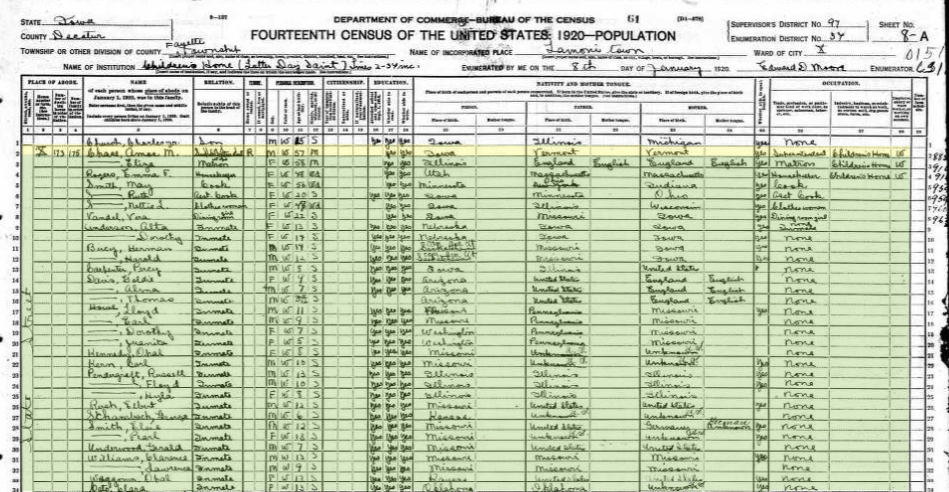
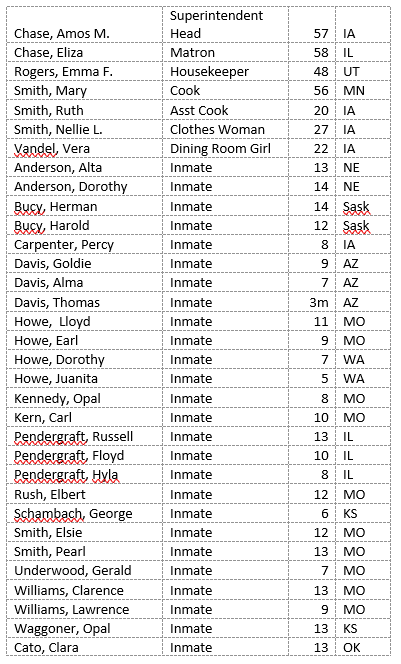
After finding the 1915 state census list (see last blog) of the Home in Lamoni, Iowa, I looked at other census years. Here are 26 names from the 1920 US Census. Note the enumeration district now lists the Home in Fayette Township which includes Lamoni.
1920
1920 US Iowa, Decatur, Fayette Township, Children’s Home (Latter Day Saints) p. 8-A
1920 CensusNames of Children’s Home in 1920 census
Dated January 8, 1920 the enumerator recorded fifteen families; their birthplaces being Arizona, Iowa, Illinois, Kansas, Minnesota, Missouri, Nebraska, Oklahoma, Utah, Washington and Saskatchewan, Canada who were in need of the services provided by the Reorganized Latter Day Saints.
The Children’s Home Superintendent is now Amos M. Chase and his wife Eliza who served as Matron. Assisted by Emma F. Rogers, Housekeeper. Mary Smith, Cook and Ruth Smith, Assistant Cook, Nellie L. Smith, the Clothes Woman and Vera Vandel the Dining Room Girl.
1925
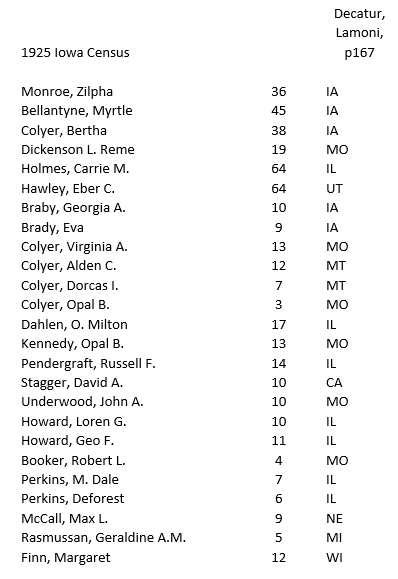
In 1925 the state of Iowa recorded another State Census. Here is the listing for the Children’s Home: State Census: Iowa, Decatur, Franklin, p. 160
This census year had multiple pages of information including some parents’ names, occupations and religion. The names or lack of names gives clues as to why they were in the Home, many of the mothers were not living.
The 05 April 1925 list included the children of Bertha Colyer who was a cook at the Home. (Virginia A, Alden, Dorcas, Opal B.) Plus twelve more family names from California, Illinois, Iowa, Michigan, Missouri, Montana, Nebraska and Wisconsin. The Superintendent is Zilpha Monroe assisted by Myrtle Bellantyne, Bertha Colyer, Reme Dickenson, Carrie Holmes and Eber Hawley.
Note: The Home closed in 1926 due to changes in Iowa laws so there are no later census records to discover.
I can’t believe how many Children’s Home names I’ve found in the census. Here is an index of all census names found (1915, 1920, 1925). There are other sources of information to be found too – more about them next time.
1911-1915 W.P. & Isabelle Robinson are Superintendent and Matron. Moved to Tulsa, OK and then Independence, MO.
1915-1916 E.D. & Alice Briggs took charge on November 5, 1915. Mother Briggs’ health steadily declined, they returned to their strawberry farm at Nebraska City, NE in November of 1916.
1916-1916 Joseph Roberts Superintendent and Sister Ressenguie and Sister Stebbins served as Matrons.
1916-1918 Father Joseph and Mother Carrie Goode from southwestern Iowa. They were formerly at the Liberty Home for the Aged.
1918-1920 Elder Amos Milton and wife, Eliza (France) Chase were employed and installed as superintendent and matron in March 1918.
1920-1921 Brother and Sister J.J. Boswell from the Walnut Park Branch at Independence, MO completed the year.
1921-1926 Zilpha Pearl Monroe.
1926 Home Closed
Lamoni History: Lamoni was platted in 1879 as a colony for members of the Reorganized Church of Jesus Christ of Latter-day Saints, who had come to Iowa from Missouri and Nauvoo, Illinois. The founding was accomplished by the Order of Enoch, a corporation formed for the purpose of purchasing and developing lands for church settlements. The place was named for a righteous “king” recorded in the Book of Mormon. In 1881, the Herald official church publication, was moved here from Plano, Illinois. Graceland College founded in 1895 as an educational center for the rLDS denomination, but the church offices were moved to Independence, Missouri in 1920. Fourteen college buildings, including several cottages, on the highest point of a 70-acre campus. A 300-acre tract of farmland, adjacent to the campus, provides employment for students, and supplies the kitchen with poultry and fresh dairy, garden and orchard products. The institution became a junior college in 1915; in 1923-24 the third year of instruction was added. Two homes for the aged and a childrens’ home were established here by the church, but the former were consolidated and the latter abandoned after legislation made unlawful the transportation of orphans form one State to another. [WPA Federal Writers’ Project 1935 report] Note: In 1910 the population was 1,541 of those about 1,400 were rLDS church members. Current 2022 population is 1,969.
Who are the children in this picture? After finding a list of names in the 1915 census noting they lived at the Lamoni Children’s Home, I was hopeful. Perhaps with this beautiful, clear photo of children at the Home I could identify them. From comparing other pictures I know that Superintendent, W.P. Robinson is on the left and Mrs. Isabelle Robinson on the far right. Helen Robinson is the woman in the back on left and Randall & Carrie (Lester) Robinson in the back on the right. Can you identify anyone else in this picture?
Children’s Home 1915
I’d like to share this project with you. Perhaps you will have ideas to share about how can we match names to faces more than 100 years after the picture was taken. Here is how I started:
Establish date and place of photo (backdrop, clothing, footwear or lack of)
In this photo I see young ladies with big ribbons in their hair, Gibson girl style hair, women in dresses, young boys in nickers, girls in boots, young men in suits.
Some girls are wearing ribbons. Some are holding dolls.
Some boys have suit and tie.
Siblings in photo?
There are 7 very blonde children (could this be the Perry family who had 7 children at the Home?).
Two dresses appear the same fabric (could this be siblings?)
Compare the photo with other similar photos (place, date).
Number each person in photo – jot down what you see. Note the little boy holding a cowboy hat, boots, buckle and bolo tie.
Ask others to look at the picture, what characteristics do they see?
In my research notebook I have created and printed out a page with each person on a page. The isolation helped me focus on each person. I clipped each face and wrote the number of where they were in the picture.
I then wrote my observations and what I hoped to learn about each person.
Using each name from the census, I searched on Ancestry, FamilySearch and myHeritage. I located relatives of 2 names, I contacted them. One knew his relative was at the Home, the other didn’t.
I reached out to families who have family pictures online. Asking them to look at the photo to see if they recognize their family member.
Ultimately, I am making assumptions, but as my dad said “who is gonna say I’m wrong?” ha ha
Even I am amazed at how much I found so fast. Recent technology is so wonderful!
My guess at who is in this picture based on names/ages in 1915 Census. (See last blog for complete list of names ‘at Children’s Home).
I utilized many genealogical sites for help. I found the Decatur IA GenWeb Decatur County IAGenWeb site very useful in finding names and pictures of Lamoni adults and church leaders. (Independence, Missouri also holds many good records for the Reorganized Latter Day Saints.) The Family History Library has scanned many records associated with the rLDS organization. (More about that soon).
There are many unidentified-photograph websites, facebook groups and genealogical societies. Crowd Sourcing is a great way to let others consider your project. Examples include DeadFred.com – it is just plain fun to look at, so much work goes into each photograph! Family Treasures Found on Facebook is one of my favorites! Amazing to see the 42,000 members go to work on identifying a possible date, location and name of person in photo or treasure. Many posts are second hand store finds!
Local historical societies are often eager to post your picture on facebook and generate some real feed back. A google search of images can be fun even when its not exactly who you are looking for. Look at clothing and hair style examples.
The facebook group “You Know You Grew Up in Lamoni If” was a wealth of info. Many local history and photo posts. And I found a Robinson family grandchild!!! They emailed me a history that Carrie Robinson wrote about the Children’s Home. When asking a family member for help, remember they may not even know their ancestor had been at the Children’s Home. Gently suggest it and offer to send photo for comparison! They may not reply but the picture you send may end up on their genealogy page (that is a pretty good hint).
Google may offer you a solution – go to images.google.com, click on the camera icon, upload your image and hit search. Amazing!
Robert was 9 years old, his sister Mary was 4, their mother had just died of TB and their father was unable to care for them. The Reorganized Latter Day Saints church offered a solution at the Children’s Home in Lamoni which provided care of church members children in unfortunate situations. Robert and Mary arrived there about 1912.
As I began to wonder about my grandfather, Robert and who the other children might have been at the “Children’s Home” many questions arose. How many were there? Who were his playmates? Who shared this experience? Are there written records?
A report in the Saints’ Herald magazine stated that the Home opened 15 August 1911. This photo is from that day, it piqued my interest. Could my grandfather and his sister be in this picture!? Very few photos of Robert are known to exist.
By the look on their faces, Robert and Mary were timid and afraid. One can only imagine the grief and confusion these young children faced. Leaving their rural farm home for maybe the first time, this picture appears to be taken in front of the Lamoni Church. Perhaps sent “home” letting the family know the children had arrived safely.
Cared for by the Robinson family who managed the Home from 1911 until 1915, I can imagine Brother Robinson welcoming them to the home. Showing the children where to put the few things they brought with them. Shown a steel framed bed and small dresser. New clothes may have been a treat. Having a doll of her own a welcomed comfort.
Who were the other children at the Home? I was surprised to see the 1915 Iowa State census taker noted “at Children’s Home” for 19 children. After 100 years here are the names in the 1915 Iowa state census. Amazing!
The 1915 Lamoni, Decatur, Iowa state census Administration age born birthplace Robinson, W.P. 46 1869 WI Manager of Children’s Home Robinson, Isabelle 65 1850 WI Matron at Children’s Home Robinson, Helen 32 1883 WI Robinson, R.C. 30 1885 WI Cobb, Lilly 20 1895 MO cook Sartwell, Vera 22 1893 IL worker in Childs Home
Note: While the 1915 census is indexed, it is filmed card by card – not full sheets as we usually see in a US Federal Census. Meaning I had to read all 30,000 Decatur County, Iowa cards to create a list of the children who were noted as “at the children’s home.” To my surprise I found 9 boys and 10 girls.
Children in the Home
Name age born birthplace Atkinson, Garland 6 1908 WA Bullock, Martha 11 1904 IL Bullock, Russell 9 1906 IL Godfrey, Anna J. 10 1905 NE Godfrey, Emma L. 13 1902 NE Godfrey Martha J. 8 1907 NE Holdsworth, Stafford 11 1904 MO Hilliard, Grace 10 1905 IL Kern, Russell 11 1904 MO Kern, Verne C. 12 1903 MO Kern, W.J. 14 1901 MO Moffett, Jean Marie 16 1899 IA Perry, Claude E. 3 1912 MO Perry, James A. 9 1906 MO Perry, Lottie Ann 13 1902 MO Perry, Marg M. 8 1907 MO Perry, Robert L. 17 1898 MO Perry, Roy D. 4 1911 MO Perry, William W. 11 1904 MO Smith, Vada 9 1906 IL Warren, Fern E. 8 1907 MI Warren, Pearl A. 10 1905 MI
Note: Robert & Mary are not listed because they were in Kansas with their older sister in the 1915 census.
Next I set out to learn more about the eight families represented.
The Bullock family was from Illinois. Parents: John W. & Martha (Naiden). Mother died 03 Aug 1909. Siblings include Russell, Daniel, James E., John W., William S. They lived at Belleville, St Clair, IL. Mother Martha died before 1920. They were rLDS.
The Godfrey family was from North Platte, Nebraska. Parents: Harvey Joseph & Fairzina (Smith) Godfrey. Mother died 03 Apr 1907. Father married again in 1910. Siblings included: Andrew, William, Charles, Luella, Emma, Cecil, Martha, Anna, Elbert, and Emma.
Holdsworth family was from St Louis, Missouri. Parents: Thomas & Evangeline. Mother died 28 Aug 1917. They were from St. Louis. There was a divorce in 1891 and a remarriage in1896. The children arrived in Iowa in 1913.
Hilliard family from Illinois. Grace age 10 possibly the daughter of William & Dora Hilliard. They lived in Clinton, IA. Siblings included: Worth, James, Robert, Wiley and Joseph.
The Kern family was from Missouri. Parents: John E. & Nalvina (King) Kern. There were 3 children with first wife, and 7 with second wife. Father was an invalid since 1908, he died in 1910. Siblings included: Flansas, Mary, Lulu, Floyd, U.G., Verne, Russell, Jossie, and Elzie.
Moffett family of Iowa. Jean Marie age 16 was child of Joseph & Nellie Moffett from Decatur County. Her name at birth was Virgean Marie Moffett. They were from Ringley, Ringgold, IA.
The Perry family of seven was from St Clair County, Missouri. Parents Arthur & Bertha Perry had eight children: Robert S., Lottie Ann, Willie W., James A., Mary M., Rob D., Claude E., and Dortha Bertha born in 1909 died on 07 Mar 1914 at the Children’s Home.
Smith family Illinois ??
Warren family from Michigan. Fern age 8, Pearl age 10 were children of Burt & Alice Warren. Other siblings Noah & Geraldine. The mother died on 10 Aug 1913 at Lansing, MI. The father remarried 14 Sep 1914.
Can you picture meal time in the Home? Likely a table full of boys including those closest to Roberts age (12) were: Stafford Holdworth age 11 Russell Kern age 11 William W. Perry age 11 Verne C. Kern age 12
The table of girls included Mary age 8 and those closest to her age: Martha J. Godfrey age 8 Marg M. Perry age 8 Fern E. Warren age 8
Now with a list of names I was stunned to find a beautiful, clear photo of children at the Home. I believe this was near the same time as the 1915 census. W.P. Robinson on the left and Mrs. Isabelle Robinson on the right. Randall & Carrie Robinson and Helen Robinson also. Can you identify anyone else in the picture?
My next project is to match names to faces. How can that be done more than 100 years later? I’ll save that for next issue.