Children’s Home, Chapter 2

Located in southwest Iowa, The Children’s Home at Lamoni, Iowa was familiar with a good winter blizzard.  So while many of us are experiencing winter weather let’s explore the Children’s Home and who ran it 1911 – 1915.  Lamoni is located in Decatur County, Iowa.

The Reorganized Latter Day Saints faith was thriving in Lamoni.  It was Sister Marietta Walker and the Daughter of Zion (wives of Reorganized Latter Day Saints church ministers) that started the discussion about the need for care of church members children in unfortunate situations. 

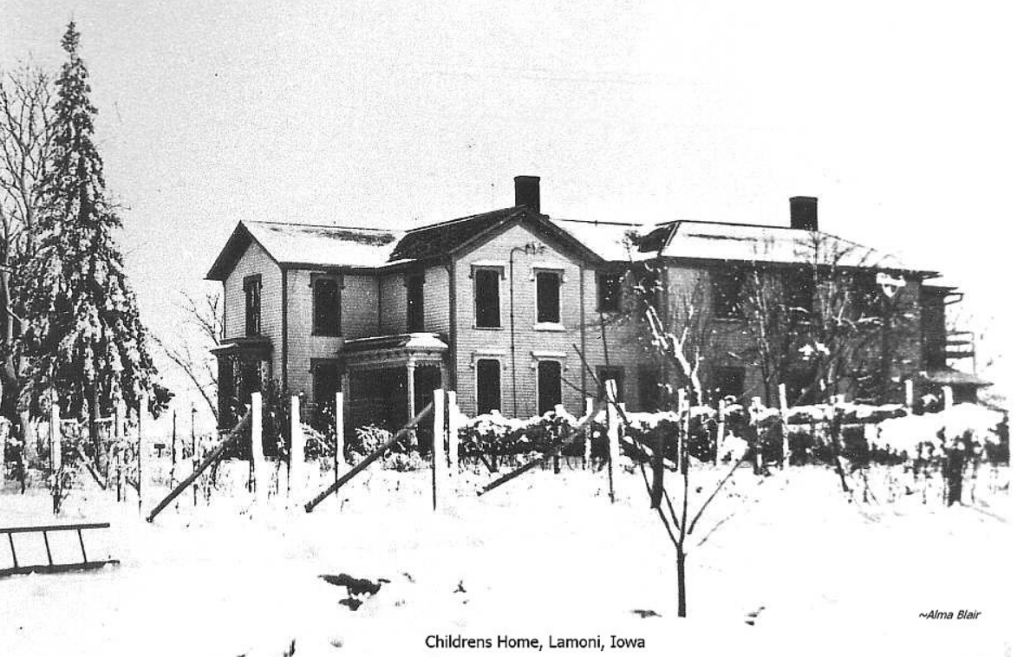
In the spring of 1911, Brother Elijah Banta’s place on South State Street, Lamoni, Iowa was purchased (arranged by Bro. E.L. Kelley) and work of preparing the place for the children was started.  The Banta family desired that the commodious dwelling be used as a home for homeless children.  The Banta Home had 10 large airy, well-ventilated and well-lighted rooms.  The house was remodeled and enlarged, so that it now had eighteen rooms, besides bath rooms and closets. The rooms were arranged to accommodate about thirty-five children.  The home had a beautiful lawn and fine large trees plus a twenty-acre farm. 

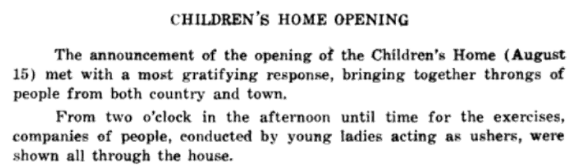
The Children’s Home at Lamoni opened Tuesday, August 15, 1911.  Operated by the Reorganized Latter Day Saints Church, the Daughters of Zion assumed responsibility for the costs. Donations of money and items kept the Home running.

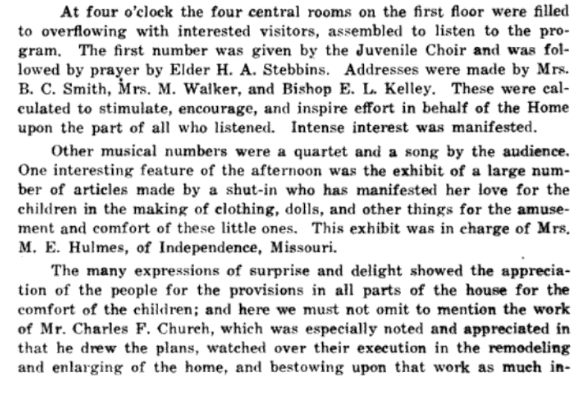
Thankfully the rLDS publications reported on the Children’s Home frequently,  The Saints’ Herald, Zion’s Ensign and Autumn Leaves to name a few.  At the time of the opening, two girls had already been received as inmates of the home, under the care of Brother and Sister Robinson.  “On this happy occasion Bishop E.L. Kelly (sic), Sister Marietta Walker and Sister B.C. Smith, president of the Woman’s Auxiliary were the speakers.  The Home Association was led by Sister B.C. Smith, President; Sister Ruth Smith, VP; Sister D. J. Krahl, Secretary; Sister Letha Tilton, Treasurer. At the formal opening, forty-one children had been admitted to the Home.  Brother and Sister William P. Robinson are superintendent and matron.”   [As reported in the April 17, 1912 The Saints’ Herald p. 385]

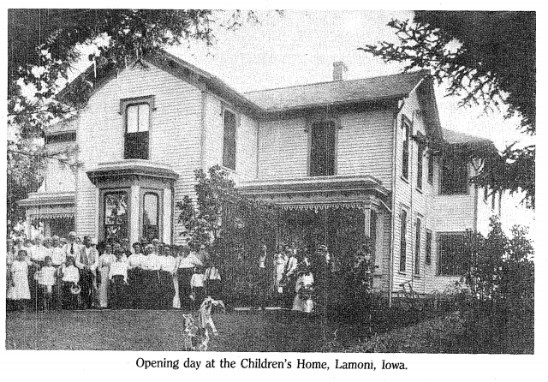
The Journal of History reported that in 1911, “Brother William P. Robinson was taken out of the missionary field (Wisconsin District) and placed in charge of the Children’s Home.”  [rLDS Journal of History, Vol. 8 (1915) p. 220]  There are several photos of the home on opening day.

From the time of opening, each month brought other children until in 1912 the limit of accommodations was reached.  The management maintained good discipline.  The assistant matron, “Sister Helen is doing all she can to help the children with their lessons.  The matron, Sister Robinson was described as having “a pleasant face and loving service.” 

At the incorporation of the Children’s Home, “The purpose of the Home was to receive, adopt, care for, place out for adoption, and improve the condition of destitute, abandoned, abused, ill-treated, friendless and orphan children, to secure and own suitable ground and tract of land, to erect and maintain suitable buildings where such children may be provided for education.”

By 1913 the Home was managed by a board of trustees in association with the Saints’ Children’s Home Association, it was not intended to be a boarding house, reform school or sanitarium. 

The Incorporation bylaws went on to state: “The board guarantees to use all the care and inquiry possible to secure proper homes, and when placing children in homes reserves the right to take them back if those who have received them do not give them proper care.”  Efforts were made to place two or more of one family together.

The Children’s Home Manager, W.P. Robinson and wife, Isabelle had two sons and one daughter.  The Robinson family began to grow as son Randall was married on 20 Aug 1912 to Carrie Bennett Lester at Decatur, IA.  They also worked at the Home.  Son Charles E. Robinson was married in Lamoni March 26, 1913 to Edna Lucinda (Harger) Hartschen, witnessed by sister  Helen I. Robinson age 25. Married by Elder W.P. Robinson.

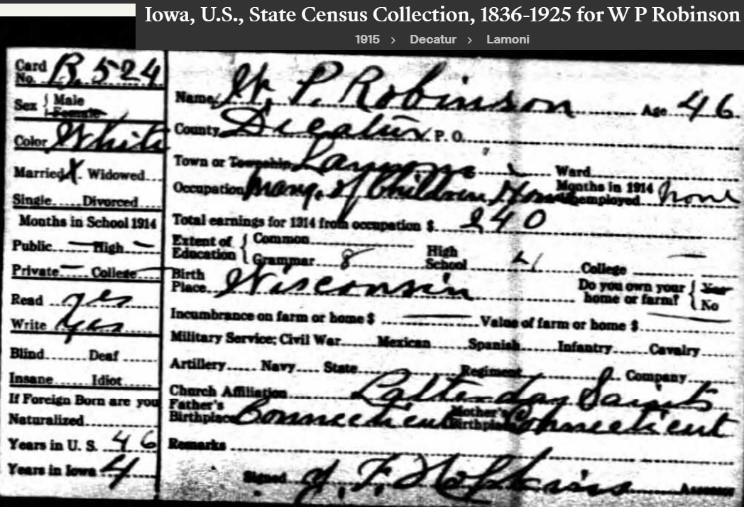
In my quest to learn more about the Superintendent of the Home, I went to the 1915 Iowa State Census.   There I found W. P. Robinson, age 46, born 1869 in Wisconsin.  It states his occupation as Mang. Of Children’s Home.  He had been in Iowa 4 years.

I also located Census cards for his wife Isabelle Robinson who was born 1850 and their children:  Charles Robinson, Randall Robinson, and Helen I. Robinson.

Ancestry family trees helped me learn that William Perry Robinson was born in Wisconsin.  His parents were John B. & Serena S. Robinson.  W.P. grew up at Oregon, Dane, Wisconsin.

On 08 Apr 1879 William Perry Robinson married Isabelle L. Dick at Dane, WI. 

W.P. and Isabelle lived at Oregon, WI in 1880, 1900, 1905.  The 1910 census found him at Rockford, Winnebago, IL.  At age 51 he was a Missionary LD Saints.  With wife, Isabel and son Randall C. Robinson. (note he joined the rLDS church in 1895).

To my surprise the 1915 census list included names of twenty one children “in the Children’s Home.”  More about them next time.

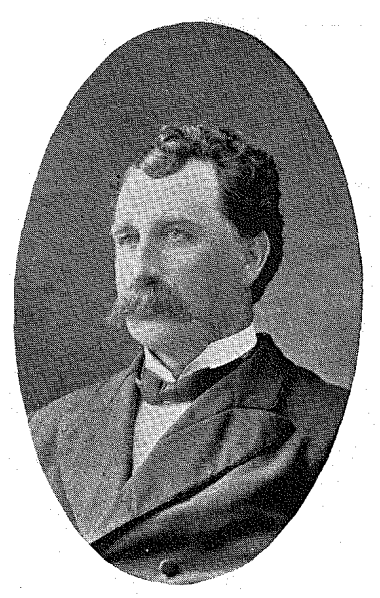
What a treat to find a photo of W.P. Robinson in an online Archive of rLDS ministers.

[Ministry and Workers Reorganized Church of Jesus Christ, Ensign Publishing House, Independence, MO http://www.latterdaytruth.org/pdf/101221.pdf]

Why my curiosity regarding the Children’s Home?  My biological grandfather, Robert E. Lee Hays was sent to the Children’s Home in Lamoni, Iowa after his mother died.  More about Robert next time.

A United States report “Children Under Institutional Care 1923 reported that the Saints’ Children’s Home was founded in 1911:

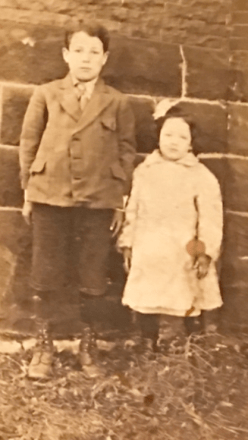
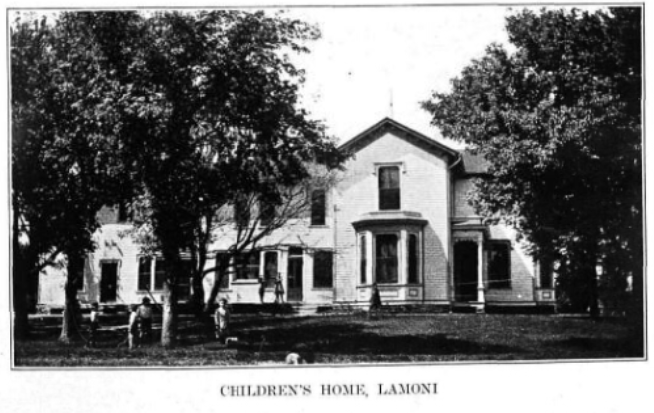
This photo in the History of Decatur County Iowa and Its People by  Prof. J.M. Howell and Heman C. Smith, 1915, p. 156.  Could this be our Robert playing in the front yard of the Home?

When the operating policy appointed a board of seven trustees to the Children’s Home the following were selected.  Richard Bullard and Callie B. Stebbins, Heman C. Smith, Lucy L. Rossenguie, Joseph Roberts, Oscar Anderson and Minnie B. Nicholson.  “The Home is still operated under the superintendencey of Brother W.P. Robinson and family.”

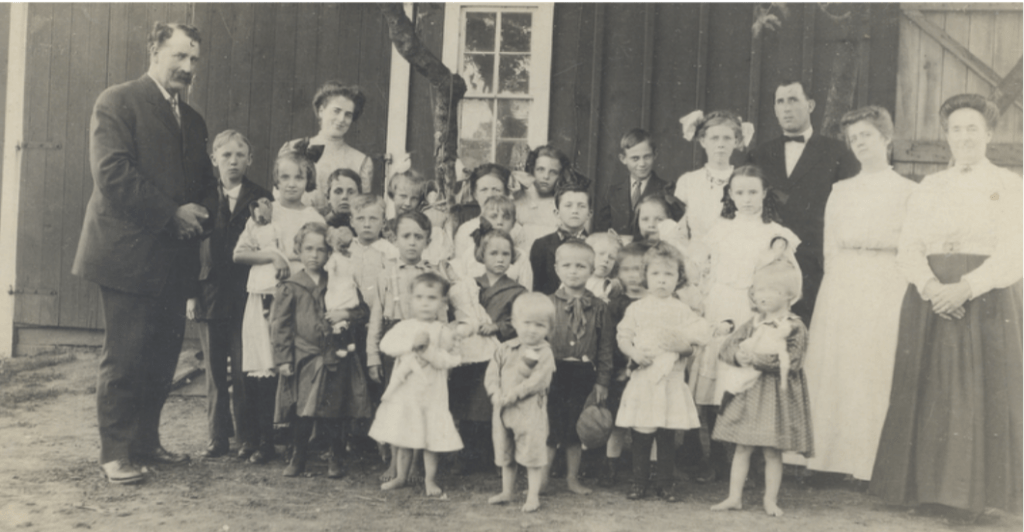
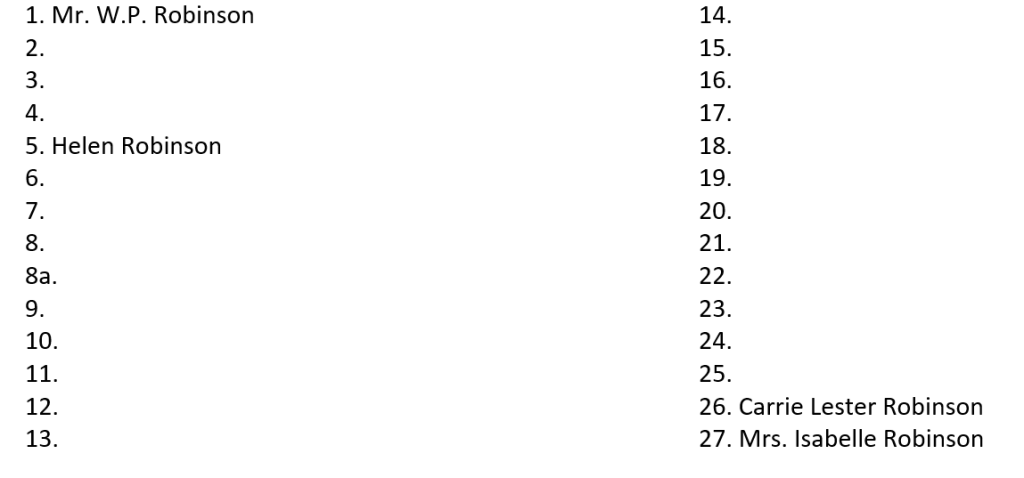
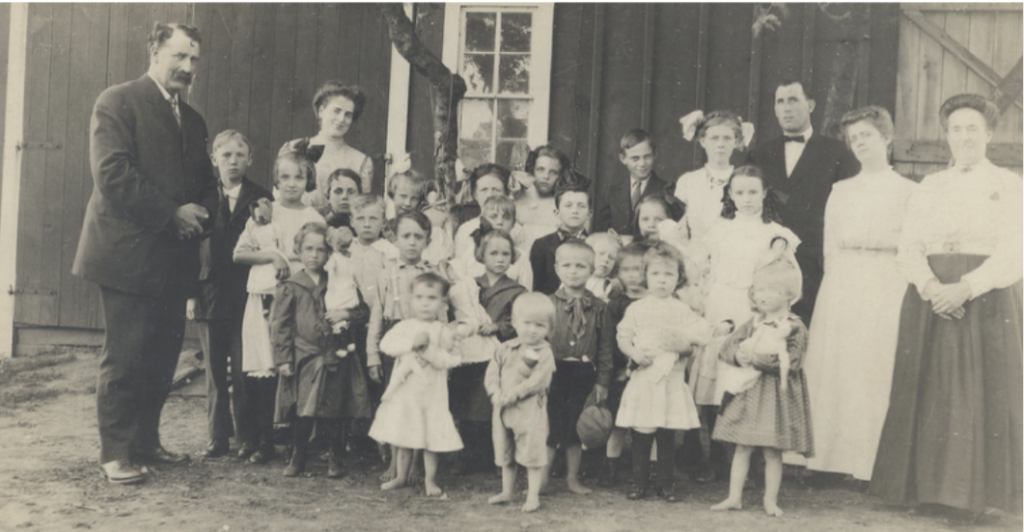
In this picture a happy crowd is on the front lawn of Children’s Home at Lamoni – date unknown http://iagenweb.org/decatur/earlydecDocs/lamoni.html

[p. 364 Journal of History. Vol 16 Journal of History, January 1923 on Google Books]

As you may recall from my last post, the Christmas of 1913 was quite a night at the Children’s Home.  The Zion’s Ensign magazine reported “On Christmas night an entertainment was given at the Children’s Home by those living there.  The long dining room was beautifully decorated, and a lare gathering of those interested in the home witnessed the excercises by the little folks, under the skillful managemnt of Sr. Helen Roginson (sic), daughter of Br. And Sr. W.P. Robingon (sic), who conduct the dailylife there.  Sr. Helen has the tact, ability and preserverance so much needed in training, directing, and getting good results.  Then the tree was unloaded of the presents for each child. 

So what happened to W.P. Robinson?  In October 1915 after leaving the Children’s Home he went to Tulsa where he went to work for the church again – having charge of the Order of Enoch House in Oklahoma.

27 Dec 1918 Mrs. Isabelle Robinson, 69 years old died at her home, 131 South Willis Avenue, Independence.  Mrs. Robinson came to Independence three years ago from Tulsa, OK.  She and her husband had charge of the Order of Enoch House, and institution of the Reorganized Latter Day Saints’ Church for a year ending last September.  Surviving are the husband, W.P. Robinson; a daughter, Helen Robinson of the home address, and two sons, Charles Robinson of Independence and Randall Robinson of Lamoni, IA. [Kansas City Times (Kansas City, MO) 29 Dec 1918, Sat, p7]

The 1920 US Census puts William P. Robinson age 60 living at 131 S. Willis, Independence, Jackson, MO.  His occupation is Preacher.  His daughter Helen I. age 36 is working clerical office.  Clyde P. age 7 is with the family.  His wife Isabelle had died in 1918.

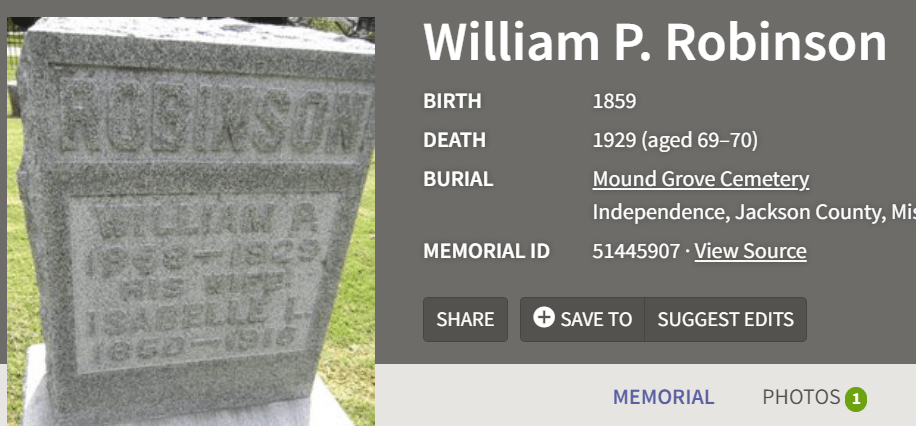
Death of Willie Perry Robinson: was born in Footville, WI, January 22, 1859.  He married Isabelle L. Dick April 8, 1879, and to them four children were born, one dying in infancy.  The surviving are Charles Edward, West Plains, MO; Mrs. Frank Knight, Oregon, WI.; and Randall Claremont, of Lamoni, IA.  In the early years of his life, after attending the meetings of Moody and Sanky, he joined the Baptist Church but afterward he and his wife became members of the Methodist Church.  In 1895 he and his entire family united with the Latter Day Saints Church.  Elder E.M. Wildermuth being the officiating ministry.  In August of that year he was ordained an elder and later a seventy.  He began his work in the missionary field in 1906 and continued his labor there until forced to give it up by a serious affliction which finally caused his death.  He was a patient sufferer for many years and March 14, 1929, in the afternoon, passed from mortal life.  The funeral was from the Stone Church, Independence, sermon by Joseph Luff, assisted by W.D. Bullard.  Interment in Mount Grove Cemetery. [Saints Herald vol 076, page 383]

[

Do you have anything to add? I’d love to hear from others that know the History of the Children’s Home.

Christmas at the Children’s Home

This holiday season my mind turns to the children who were at the “Children’s Home” in Lamoni, Iowa for Christmas 1912.  As reported in a church publication, 37 children were in attendance.  Who were these children?  Where were their parents? 

My wish for Christmas is to know more about the children in this story.

Christmas at the Children’s Home (February 1912 Autumn Leaves.  The Department of the Woman’s Auxiliary of the rLDS Church, editor Callie B. Stebbins)

“At the home, thirty-seven happy children climbed the stairs with their arms full of presents at the close of a delightful evening, during which they contributed their share of effort for the enjoyment of others in a program for which they had been drilled by Miss Robinson.  Sr. Helen is the big sister all this family, and while she is greatly beloved by them, they are very obedient to hear her and her careful training resulted in a well-prepared songs and exercises in which the children, from the largest to the least, faithfully performed their parts.  One exception there was, a little newcomer, who was a great care to a smaller child next to her, for she had to be repeatedly turned around from gazing at the Christmas tree.

Christmas Eve coming on Sunday the wide doorway between the living room and the reception room had been sealed with a covering of heavy paper.  In the reception room, against the bay window, stood the Christmas tree, not to be revealed until it should stand resplendent when the lights were turned on in the evening.

The big turkey dinner claimed attention in the middle of the day, and late in the afternoon, when it was getting very hard to wait for evening, the big-hearted near neighbor brought over an immense bag of peanuts – enough for everybody to have all they wanted; and when they were gone it was getting dusk and time for the evening lunch, and then to get ready for the program – and the tree!

Chairs were arranged in the living room facing the tree at the father side of the reception room, and here was seated a little company of friends, only room enough remaining for a passageway for the children, who were gathered in the dining room and who marched back and forth to music at their turns for taking part in the program.

When all was ready the music began, and then the children came, all of them except the two babies, one of whom was in bed, asleep, while the other, a pool little chicken-pox patient, on the road to recovery, made his appearance in “Father’s” arms when he stood in the wide doorway to announce the opening number and ask all the friends to join in singing it.

The line of children filed past the guests, through the little hall-way at the foot of the stairs, and across the room, where they turned their backs upon the tree and stood in graduated tiers, the tall ones in the rear and the wee ones in the front.

The leader of the church choir had led as many singers in a glorious cantata the night before.  To-night looking out with others from a corner in the stairway, she could not find her voice to join these homeless ones in the new home provided for them.  And others were there who were not much help to the children though they tried to master the feelings that rose to cut off the song.

But the children surely were happy, and when the program was over, released by “Mother,” who with “Edna” had them in charge in the dining room, they came flocking back to face the tree and exclaim and laugh and chatter, they were still as entertaining to their audience as when they were consciously trying to be so.  Then they were quieted down, and, seated on the floor, they received their presents as their names were called, until each had a lap full.  They were allowed a little time of enjoyment and then marched upstairs to bed, to fall asleep with joyous anticipations of to-morrow with their new possessions.”

Did someone in your family spend time in a Home or Orphanage?

Ps/ I believe Robert L. Hays was one of the children who received a gift that night.  His mother had died the previous July, she was a member of the Reorganized Latter Day Saints church who ran this Home.  Family says his father was unable to raise him.

Military History in Newspapers

With Veterans Day approaching, I want to honor all those that served in the military.  Here are a few ideas of what you might find about your ancestors while searching in newspapers.

  • Many newspapers in the Civil War era published a “Sons Letter Home.”
    [Thomas Canfield, Fayetteville Semi-Weekly Observer, (Fayette, NC) 12 Sep 1861, Thu p2]
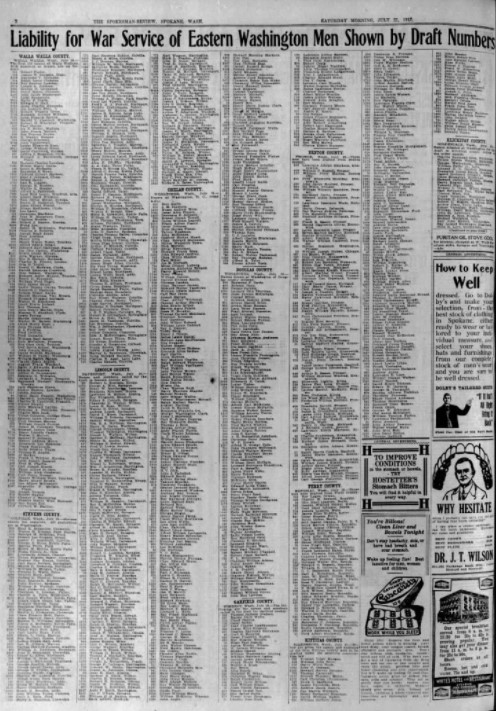
  • In World War I and II, Draft Lists were published as the names of those drafted were announced by the draft board. [The Spokesman Review, (Spokane, WA), Sat, 26 Jul 1917]

[The Cincinnati Enquirer, (Cincinnati, OH) 24 Mar 1945, St, P13]

  • “The Stars and Stripes,” a military magazine was founded in 1861.  It is available and searchable at the LOC.GOV
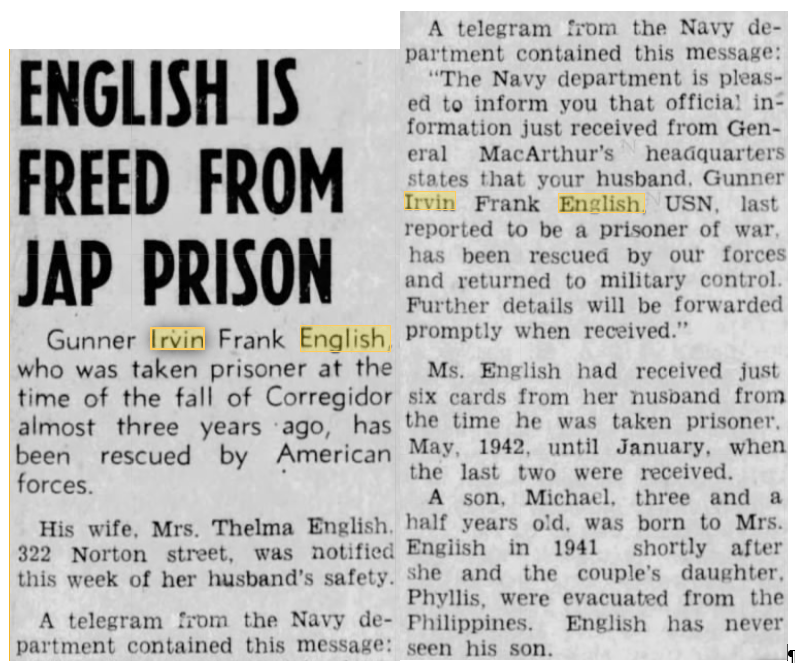
  • Casualty lists were regularly published in local newspapers.  Killed in Action reports were posted as well.  Returned prisoners of war were often noted [US.  National City Star-News (National City, CA) 23 Apr 1945, Fri, p1]
  • Of course you can search for your military-ancestor by name and perhaps you will find their obituary. Dennis E. Higgins [The Post-Star (Glen Falls, NY) 08 Feb 1966, Tue, p16]
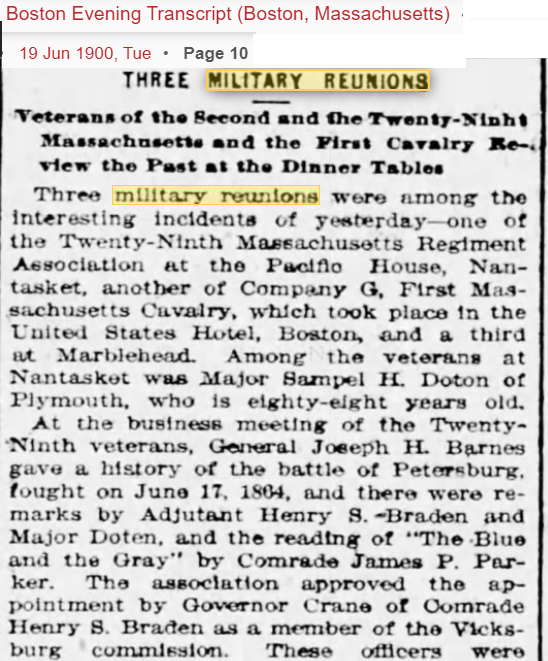
  • Military reunions were often hosted by the GAR, states and units. This example includes the Twenty-Ninth Massachusetts Regiment, Company G, First Massachusetts Calvary. [Boston Evening Transcript (Boston, MA) 19 Jun 1900, Tue, p10]

Happy Hunting!  Let us know what you find.

Records, Records, Records

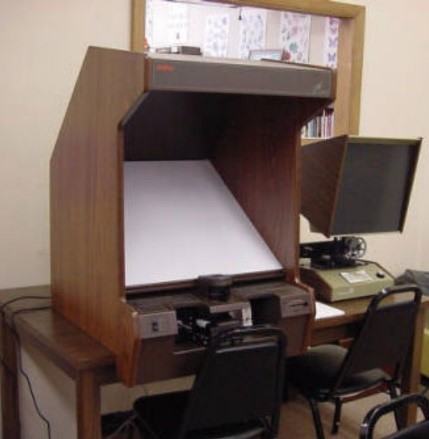
Hand crank microfilm readers 1960s

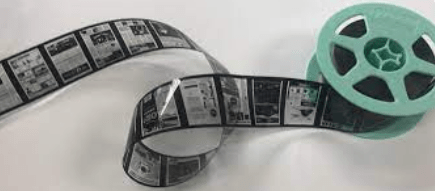
Whenever I have visited the Family History Genealogy Library in Salt Lake City, Utah (SLC), I have felt like it is genealogy-heaven!  Rows and rows of books, microfilm and microfilm readers.  What is microfilm you ask?  It is a film-roll containing microphotographs of documents  One roll of film may contain more than 2,000 images.  These included family histories and vital records.

The Church of Jesus Christ Latter Day Saints actively visited court houses and scanned their public records to microfilm. As items were submitted they were often microfilmed to save space. There were about 100,000 films available back in my early research days.  I can tell that from my pre-teen handwriting where I transcribed what Family History Library number was on the box. 

Fast forward to year 2000 when there were about 4,000,000 films and many more microfiche which is an even more condensed storage method.  These were available in SLC and you could request them on loan at local Family History Libraries, paying short term fee.

Microfilm reader bout 1980 (automatic)

After 83 years, FamilySearch announced the completion of a massive project to digitize its collection of millions of rolls of microfilm. 

You can see the press release here:

FamilySearch Completes Digitization of Microfilm Collection

Roll of microfilm

The September 21, 2021 press release Announces completion of its 2.4 million rolls of microfilm.  The images contain over 11.5 billion names from 200+ countries.

Amazing to think that back in 1938 when the Genealogical Society of Utah began utilizing microfilm to preserve images it was state-of-the-art technology.  One can only imagine what the future of genealogy technology will look like!

In 2017 FamilySearch ended its microfilm loan distribution to family history centers.  In 2019 the Covid Pandemic intensified the need for research to be completed outside the library which closed its doors for a time.

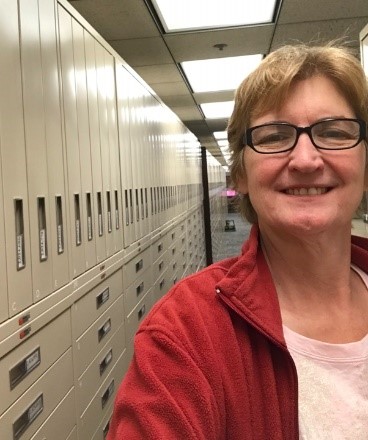
Rows of microfilm storage in SLC

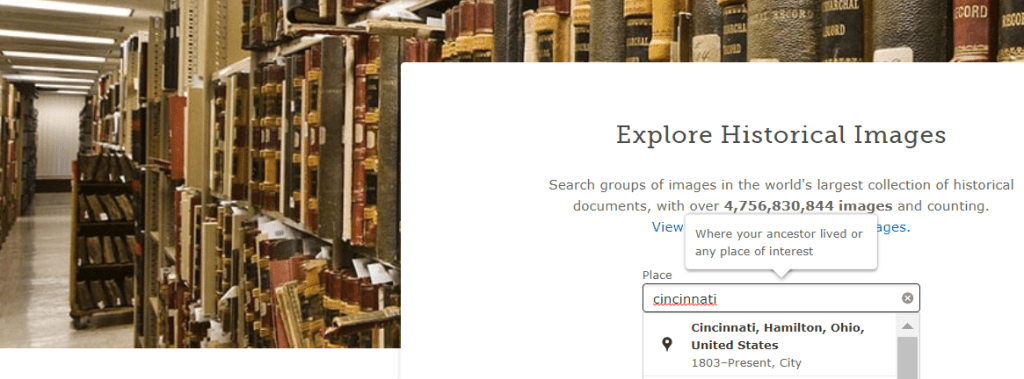
Now, instead of having to make the trip to SLC to view the film – you can now log into FamilySearch and find the film roll.

Not all records are indexed (that is in progress) but the Images feature enable users to peruse digitized images from the microfilm collection.

You do need to register with FamilySearch, but the site is free.  My grandma, who took me to SLC library when I was a teenager, would be shocked to learn that I view these documents from my recliner.  Things like Irish church birth records from the 1700’s, census records, national and international sources.

Family history and random genealogically-related subject and location titles can be searched.  These records include death records, marriages, census, land, military service, immigration, and other types of documents.

To gain access to microfilmed holdings visit http://www.familysearch.org/films .

Some documents may be restricted (i.e. most states limit access to birth records for 75 years). FamilySearch website has excellent tutorial guides and videos!

So check it out and let me know what you find!

PS/ I knew, even as a kid, genealogy would become a “thing” some day!

Here is an example of what the screens look like:

Family Search Home Page

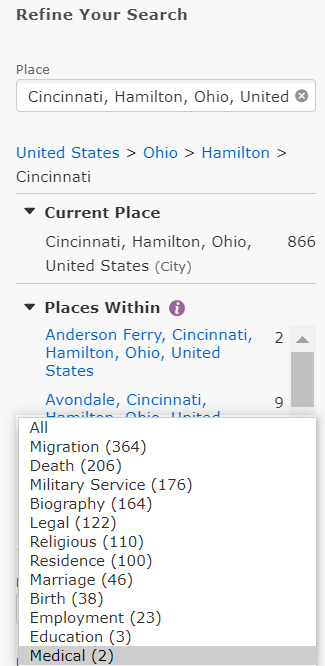
Refine Your Search

Film # 1,783,645 Cincinnati Medical Records –

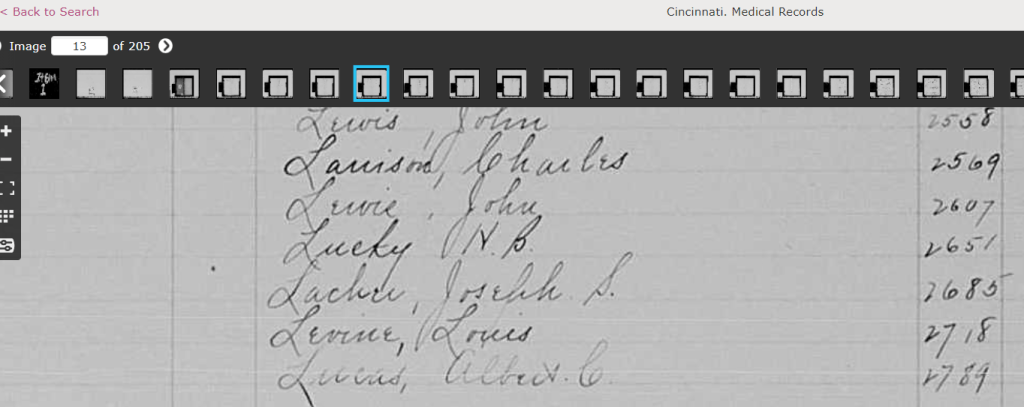
This record does have an index.  Scroll page by page like you would on a microfilm reader.

Index

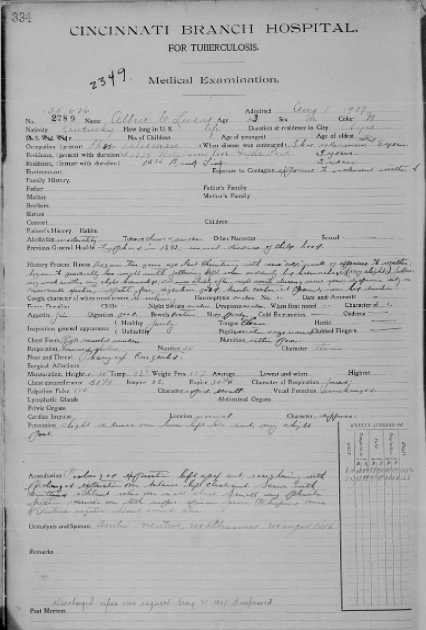
Then find the name or page.  Lucas, Albert C. This one was tricky because the numbers do not seem to match – but I could go by date and narrow it down.
This is a Tuberculosis Hospital Report.

Cincinnati Branch Hospital

Olympic History

Finally, the Olympics!  As if four years between Olympic competition isn’t long enough to wait, there was an extra year delay due to Covid Pandemic.  From July 23 – August 8, the 2020 Olympics are underway in Tokyo, Japan.  From August 25 to September 6 the Paraolympics are also in Tokyo.

For my family and much of the world this is a time when we are focused on watching the best athletes competing at the Olympics.  As I watched, it got me thinking about athletes participating and the ways their history is being preserved.

I was pleasantly surprised that there are many books and plenty of online Olympic history resources.  In 2021, it seems each athlete has their own web page, the hosting country may have a page and the entire 2020 Tokyo Olympics has its own medal results page.  Beyond that there are event specific and official and unofficial result pages.  The media has done a great job of presenting a variety of human interest stories that includes family connections.

Here is a web site that lists everyone who has ever received a medal: 
https://olympics.com/en/athletes/

These records go back to the “modern” Olympics starting in 1896.  It was eye opening to think back that when the Olympics first opened in the Greek capital, there were only men competing from a few countries and now they boast more than 11,200 competitors representing 207 nations.

Were you lucky enough to have a member of your family in the Olympics?  Medal winners?

https://www.olympicgameswinners.com/

I’ve discovered a little Olympic story to inspire you.

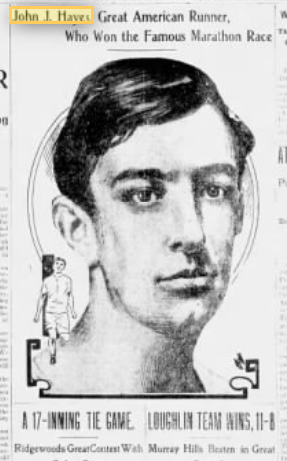
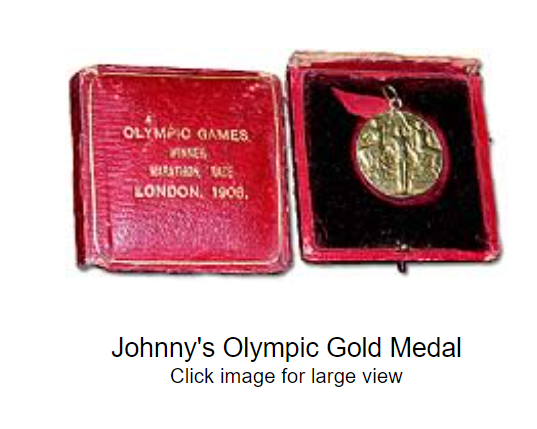
Little Johnny Hayes winner of the 1908 London Olympics Great Marathon race! [The Buffalo Sunday Morning News (Buffalo, NY) 30 Aug 1908 p1]

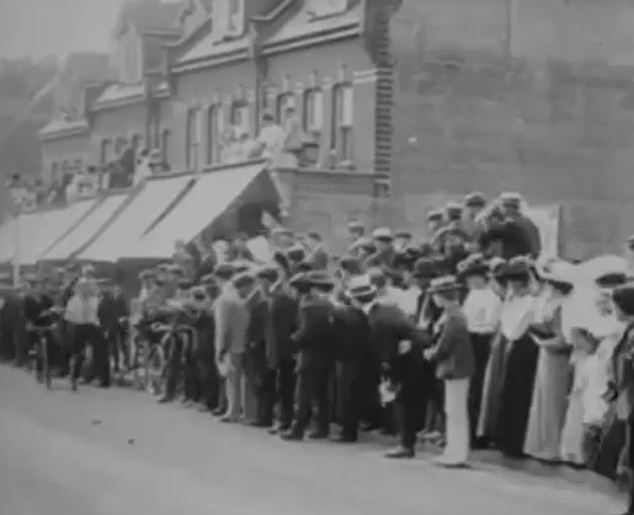
John J. Hayes made world history with his completion of the 26 miles and 385 yard run.  A featured profile on the Running Past web page included a photo a short movie clip of the crowd watching the run! 

http://www.runningpast.com/johnny_hayes.htm

The race was 2 hours, 55 minutes, 18.4 seconds and of course there was a little back story to this big win as Johnny was not favored to win.  On a hot, muggy day, South African Charles Heffernan and Italian Dorando Pietri were battling for the marathon lead when, about two miles from the finish, Heffernan reportedly accepted champagne from a fan, got dizzy and faded. That left only American John Hayes to chase Pietri.  Pietri entered Shepherd’s Bush Stadium first but then the heat got to him. He began staggering the wrong way, was redirected by officials, then fell. Officials helped him up but he collapsed several more times before struggling across the finish line first, in the arms of an official.

The Italian flag was raised just as Hayes entered the stadium and finished. American officials promptly protested that Pietri had received illegal help. The protest was upheld and Hayes was awarded the gold medal.

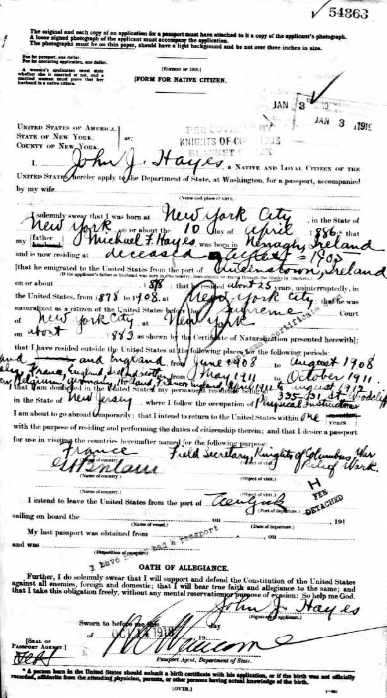
I learned from his 1919 Passport Application that his family was from Nenagh, Ireland and had arrived about 1886.  His father Michael F. Hayes was deceased in 1905. 

As any good genealogist I wanted to see Johnny and his family in the US Census.

1900 US Census NY, NY, Bronx, District 0981 – 562 139th Street, Bronx, NY

Hayes, Michael L.         40        Ire (Ire/Ire)      1880 immigration       Baker
Nellie              38        NY (Ire/Ire)
John                14        NY (NY/NY)     at school
William           13        NY (NY/NY)     at school
Harriette         10        NY (NY/NY)     at school
Daniel              5         NY (NY/NY)
Phillip              3         NY (NY/NY)
Alice                 8         NY (NY/NY       at school

22 Aug 1906 John Hayes married Annie Mauler

1910 US Census –New York, New York, Manhattan, Ward 6

Hayes, John                 28        New York (Ire/Ire)       Janitor Office Building
               Anna A.           26        New York (Ire/NJ)       Packer Drugs04 Nov 1914 John

1915 State of New Jersey, Hudson, Union, First Ward, Sheet 17

Hayes, John     Apr 1886        29        NY (NY/NY) sic            Director
            Anna   Jul 1884           30        NJ (NJ/NJ) sic             Housewife

1920 US Census – NJ, Hudson, North Bergen

Hayes, John J.  33        NY (FreeStateIrish/NY)           Broker Inspector Ship
Anna E             31        NJ (NJ/NJ)
Doris E             4          NJ (NY/NJ)

1930 US Census – NJ, Hudson, North Bergen, 100 33rd St

John J. Hayes  43        NY        (Free State Irish/NY)   Broker Food
Anna E             43        NJ        (NJ/NY)                         Proprietor Dress Shop
Doris E             15        NJ        (NY/NJ)

1940 US Census – NJ, Hudson, North Bergen

Hayes, John J.  52        NY City , NY                 Salesman Broker Canned foods
Anna E.            52        Jersey City, NJ             Housewife
Doris A.           22        Union City, NJ             College 3rd year Teacher Public School

It seems Johnnie lived a happy life.  His daughter later would describe her life included attending sporting events with her father.  He died in 1965.

[The Record (Hakensack, NJ) 25 Aug 1954, Wed p 58]

An obituary was posted in newspapers all over the US and beyond.  His Olympic success was not forgotten.  And his daughter, Doris, carried his gold medal in her purse!  He was buried at the Holy Name Cemetery in Jersey City, NJ.

Wikipedia summarized Johnny’s bio born 10 April 1886 and died 25 Aug 1965.  He was a trainer for the 1912 Olympics.  He later taught physical education and was a food broker.  He had a guest appearance on the tv show “I’ve got a Secret.”  He died in Englewood, NJ.

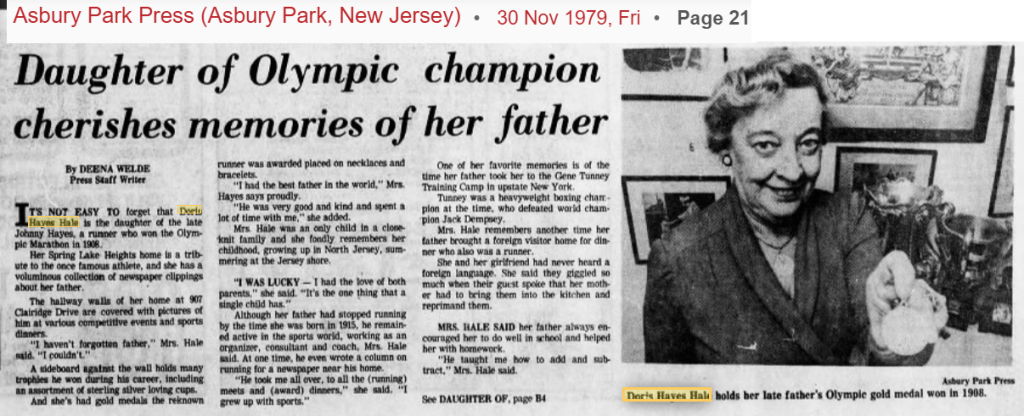
It warmed my heart to see this newspaper story about Johnnie’s daughter Doris Hayes Hale. 

I get a sense she was very, very proud of her father’s accomplishment.  With no children of her own I wonder “where is that medal now?”  Doris died in 2001.

answer: https://www.shoreac.org/johnny-hayes.html#/

Now back to humming the Olympic Theme Song when I accomplish simple tasks at home.

Where to find photos of your family

I’ve been asked several times recently “where can I find photos of my ancestors.” 

I am guessing you have already looked at home, in the attic and asked your relatives.  

Here are a few suggestions:

  • High School Yearbook (online or at the school library) remember that often the year book uses an initial and not a full name.
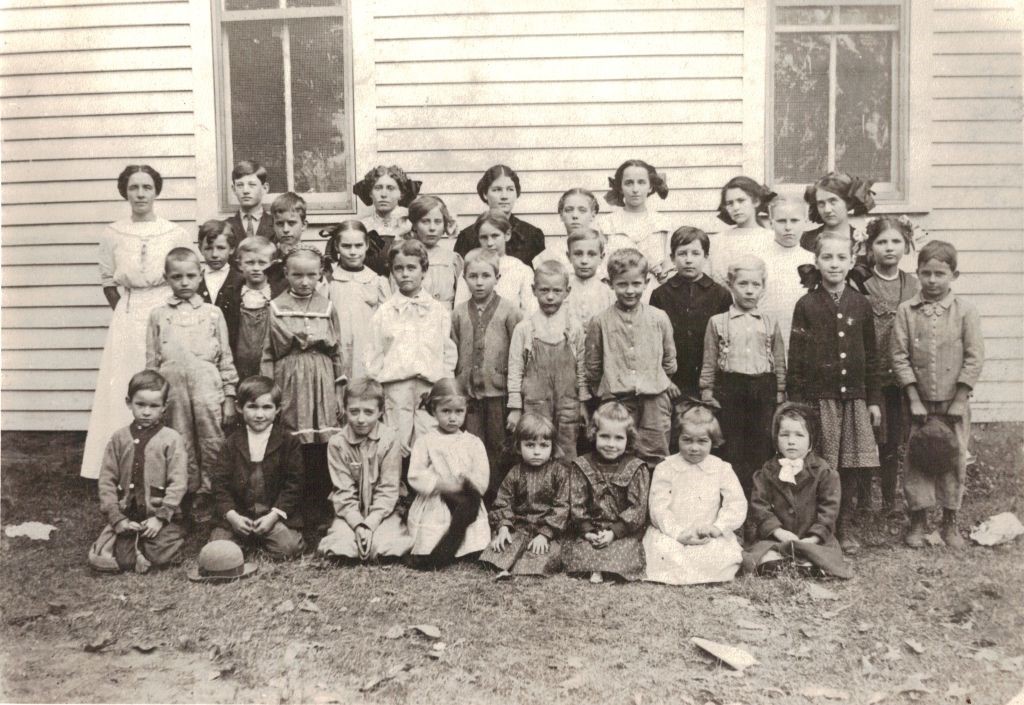
  • Grade School Pictures – I found that Missouri State Archives had an annual report and some schools were photographed. While not named it could be fun to figure out who is your grandmother

1911 Taberville School

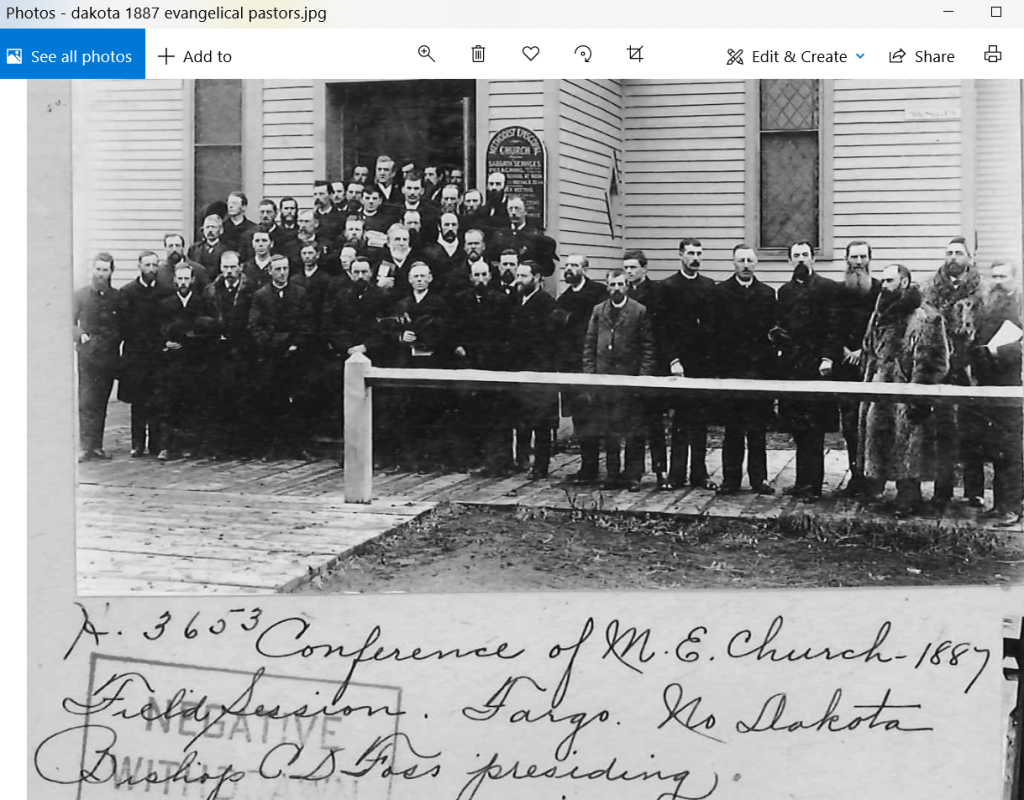
  • Professional Groups such as pastors, teachers, railroad workers, etc. This treasure is the Evangelical Pastors in North Dakota 1887.  This was in the Church Archives.

Historical Photographs (cmalliance.org)

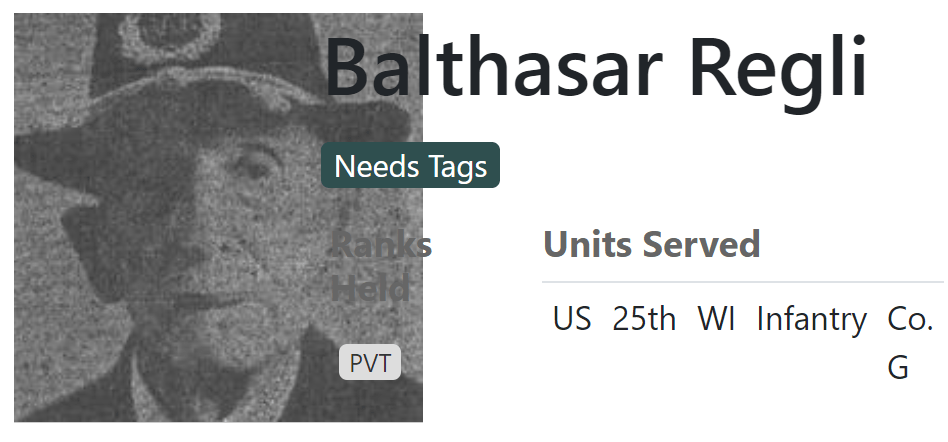
  • Military (search by unit not by name).  Example www.civilwarsleuth.com has a massive project to identify Civil War Era Photographs.
  • Pintrest
  • Flickr
  • AncientFaces
  • DeadFred – for years this has been a favorite site for folks who have found photos and want to share with the family they belong to.
  • Digital Public Library of America – this treasure hosts 43,864,848 images, texts, videos, and sounds from across the United States.  Search by subject.
  • FamilySearch.org
  • Library of Congress
  • My Heritage
  • National Archives
  • New York Public Library Digital Gallery
  • Findagrave – more and more people are posting photos along with the gravesite.
  • Lost and Found Photos on Facebook sites
  • Ebay
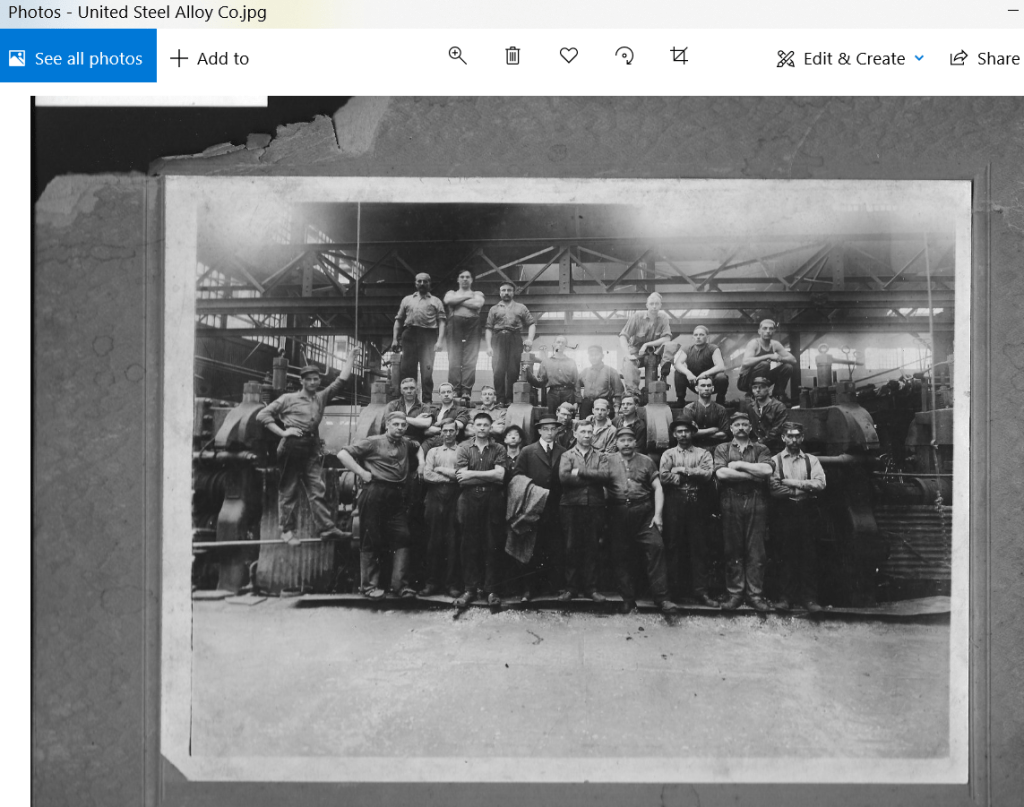
  • Anybody have steel workers in their family!?  This was posted on United Steel Alloy Company’s website.

Heirlooms

Ten reasons to cherish your families heirlooms:

1.  You might discover the heirlooms are of more meaning to you later in life.
2.  They might be worth a lot of money.
3.  It could inspire you to learn the history of your family and the items they cherish.
4.  It would make your grandma happy.
5.  Restoration and reuse is good for the planet.
6.  They will create conversation in your home.
7.  Heirlooms connect you to your family history.
8.  They don’t make stuff like that anymore.
9.  Your grand-children may want a polaroid camera!
10.  You’ll have something special to pass down to your kids and grandkids.

While reading a recent article “The Family Heirlooms That Our Children Don’t Want” By Robbie Shell, Wall Street Journal, April 10, 2021, I was reminded of when I was about 15 years old and we gathered at my grandmother’s home to help her downsize.  She offered certain pieces of furniture, dishes and other items to her daughters and her grandchildren.  It was obvious that these items meant a lot to Grandma.

I didn’t need furniture, dishes or nick-nacks at the time and I wasn’t sure of the value of the handiwork, the doilies and embroidery, yet I took some home.  I actually didn’t have a clue what I would do with these items, but I took them and we pinned notes to each piece about who made them and why they were important.  By then I was already very interested in family history research so I treasured all the items that we could connect with an ancestor.

Some of the family photos and historical documents (letters) helped me fill in my ancestor chart!  Grandma would say “now you sit down here beside me and let me tell you about this.”  When I think back of how her family of seven came from Montana to Washington, in an Overland car, I marvel that she had anything to remember her childhood with.  Maybe that’s why she treasured what she had worked so hard for.

Just like the WSJ story, grandma was disappointed that her family didn’t want the cut glass candy dish that was given to her by a family friend.  It no doubt left her feeling sad.

When my grandma passed I was in my 40’s.  Looking again at her life treasures now it was complicated by “what to do with these items.”  Where would I put it?  What would I do with it?  I did have a home but it was full of my stuff!

Ms. Shell reported “My myopia continued with an attempt to interest my son and his wife in a beautiful mahogany-trimmed white couch in the basement that no longer fit into our current house. The reason for their rejection was now becoming familiar: “Too ornate.”

Now I find myself as a new grandmother pulling out treasures I saved all these years since my children were little.  I have an amazing toybox:  sturdy Fisher Price toys, precious books and darling little outfits that are filled with memories and good feelings (for me at least).  The look on my daughters faces let me know that they weren’t going to be putting a 30 year old onesie on their newborn!  I settle for “okay let’s take a picture in the dedication-gown which has been used in our family for generations,” I reply “come on – one picture of the four generations – pleeaasseee!!”

I don’t sense that my kids are that excited to have a 30 year old afghan blanket that was knitted by Aunt Darlene and I gave up hope on them being interested in my wedding dress long ago.  It seems millennials have no intention of setting a fancy table with service for 12.  And so the china dishes, the goblets, and the silver will not end up at their house.  I must pick my battles and that one I’ll let go.

My downfall seems to be the historical papers.  I’ve gathered my grandparents letters, pictures, journals, newspaper clippings and anything they wrote.  I’ll hang on to those ‘til the bitter end and I tell my family that I am hiding money in things so they better look through them.  Who knows, by then they might get a smile from the ‘Disneyland 1992’ ticket stub with their name on it. 

The author of the Heirloom article states “more to the point, they (millennials) aren’t hoarders.  They only take what they need now.  Having seen the degraded world they will inherit, they are dedicated to sustainability, recycling, preservation of the environment, fewer material goods.” 

I realize it is my job to organize and compile my legacy research and writing in a way that is interesting and useable.  I’m working on that.  How do you do that?  Labelled boxes, shorter stories about a place or time that impacted their ancestor’s life.  I hope you will share your ideas in the comments below.

In closing I will concede there are of course valid reasons for not taking family heirlooms:

  • no one uses china dishes and goblets.
  • when is the right time to ask for the heirloom.
  • living spaces are smaller, it is expensive to store.
  • we have more money, we can buy new stuff or buy it on ebay if we want it.
  • we live in a throw-away society.
  • we move more often.
  • families live far away from each other.
  • smaller families, less children to pass things down to.
  • less in-person visits, less memories with items (i.e., the upright piano)

But oh, how I wish I had the chance to sit next to my grandma and hear her tell me one more story while we drink tea in the teacup she put my name on.

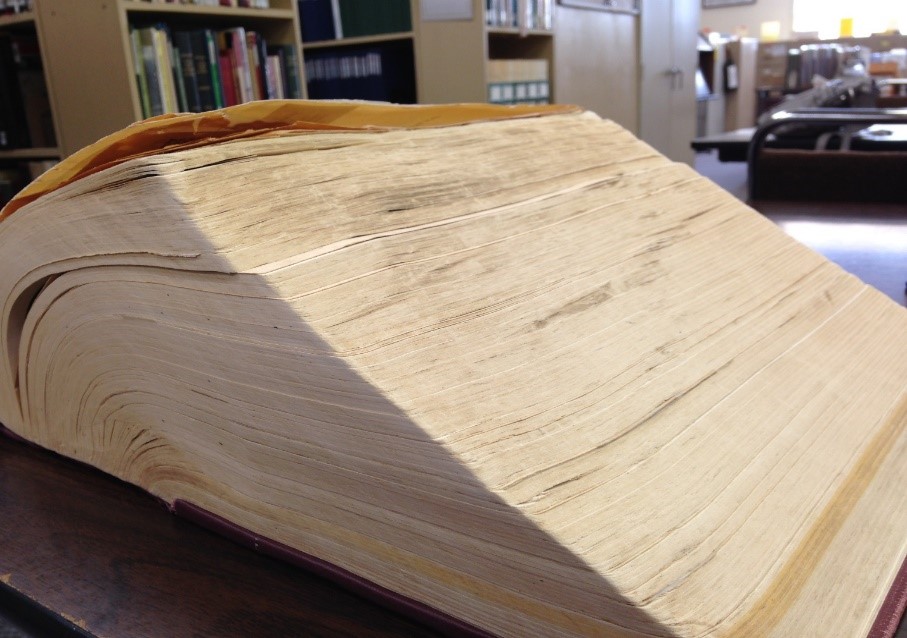
ps/ Oh and one last reason to keep the Encyclopedia – were the internet to ever crash (Twilight Zone Episode 2041) what historical information would you still have?

DNA reveals a 79 year old secret

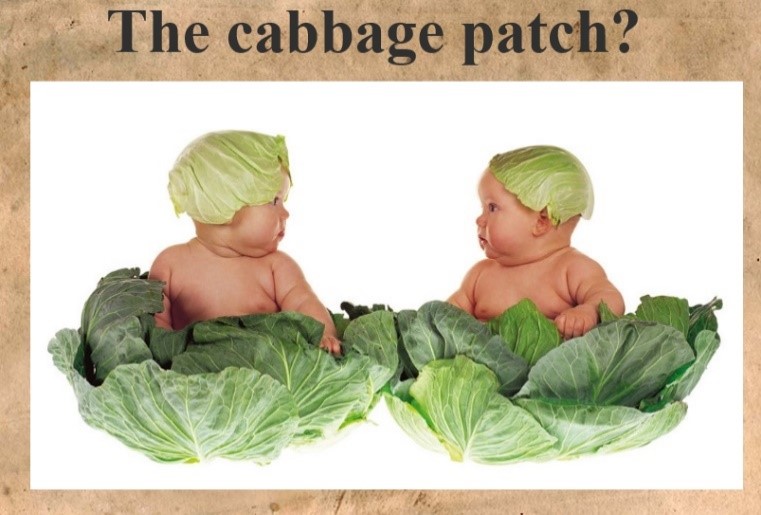
Like many adoptees Lyn knew very little about his origins.  Found in a cabbage patch his adoptive parents joked.  They told him he was chosen and loved.  He knew that and yet he also needed to know his biological origins.  He wanted to know his medical history. 

For a fee, the California State Welfare Office was willing to share “non-identifying” information with Lyn.  Tiny snippets of important information.  Their letter read:
“Unfortunately, there is very little information in the case record about the background of your birthparents.  Your birth mother was not interviewed by the adoption agency and the only information was taken from your birth certificate.” 

“Your birth mother was born in Nebraska and was 35 years old.  She worked as a housekeeper for private families.  She had one other child when you were born (age and sex not specified).  Your birth father was 34 years.  His birthplace was unknown, and at the time of your birth his place of residence was unknown.  He worked in a garage as an automobile repairman.”

“You were placed in the adoptive home when you were about 4 weeks old.”

Clues: The birthmother was born 1902 in Nebraska.  If she was still alive she would be in her 80’s (at that time).  The urgency intensified.  Searching Census records (1910, 1920, 1930) revealed thousands of possibilities for women born in Nebraska about 1902 and living in California by 1937. (The 1940 census had not been released at that time.)

Lyn, now a grandfather in his fifties, went before a California judge “as an adopted child” to seek access to his adoption case record.  We had already searched for 30 years.  Now we learned that his birth mother’s name was Edna.  Talk about a “small needle of information in a huge haystack.”

Undaunted, we were delighted with that major clue.  But where to begin?  Who were the Edna’s in Los Angeles 1937?  The Los Angeles 1937 city directory, listing everyone who worked or lived in Los Angeles, is 6 inches thick.    

We spent hours, days, weeks, months and years following up on every clue.  We explored every logical “Edna” lead.  One useful record was the voters records.  Available at the California State Library on microfilm we read every precinct one by one writing down every Edna.  There were 5,279 Edna-voter’s in 1936 in Los Angeles.  Another useful record was the index to Omaha birth records.  Those were cross referenced census records and Social Security Death Index (there were 75,681 Edna’s born in 1902 in the SSDI).

Over the years I’ve helped countless adoptees and birth parents search for each other.  Fueled by my desire to find my biological paternal grandmother and inspired by my adoptive paternal grandmother who taught me the craft of genealogy when I was just a teenager I’ve visited research facilities all over the US.  I’ve learned to utilize public documents, online records and I’ve found family stories, local history and solved mysteries.  I confidently say I’ll study the history of anything or anyone or anyplace.  Personal, local and community history is vital to the strength of anything we do.

In my dad Lyn’s case it wasn’t until 2016, at age 79, when Lyn’s DNA test revealed several second cousin matches that led us to the know he had a brother, Bob, living in California.  When I called Bob he was delighted and eager to connect. 

To my dad’s surprise, we learned that his birth mother had other children and that two of his half siblings were still living!  They never really knew about him because he was adopted at birth.  Like so many places sealed adoption papers kept them from knowing all these years. His brother and sister were so happy to know about him.

Newly found brother Bob stated he “overheard something about a baby boy being adopted out” but “it was not talked about due to secrecy.”  “I had no idea how to find my baby brother.”  Turns out the half-brothers are two peas in a pod.  When they first met, they were both wearing blue button-down shirts with a pen in their pocket.  Both love old cars and know how to fix them too.  Both have vintage Model A vehicles and had named their daughters, Janice and Janet. 

Lyn says “learning about the longevity of his siblings is inspiring, I’m 11 years younger and to see Brother-Bob still active in his 90’s, I’ve got a lot more living to do.” 

Lyn’s wife states “It has been a blessing to watch the reunion and friendship grow between Lyn and Bob, (and the entire family) I’m only sorry it didn’t happen sooner.”

Sadly my dad’s birth mother had passed away before we found them.  Bob and Lyn now travel thousands of miles to see each other every few months and enjoy their time together immensely.  They threw a huge birth-family reunion party in 2017, it was a highlight in Lyn’s life.  He had the pleasure of meeting his biological half sister who couldn’t believe how we had found them.  Nieces and nephews and dozens of cousins came to help celebrate. “Yup,” everyone said “he looks like he fits in.”

My goal is to always learn the story of the people I search for.  My PeopleStory blog is here for that reason.  For many, their family trees come together easily, but I’ve seen first-hand the agony that those searching for missing parents or children endure.  It should be a human right to know who your parents are, or where your child is.  DNA can help and as in Lyn’s case it revealed a 79 year old secret.

I created an email account to honor my grandmother EDNA and when we finally found her my daughter said “look mom it was there all the time, the answers were right there, it was in the DNA – get it, eDNA, that combined with “electronic DNA” can help solve mysteries.

So if you know of anyone who has gotten their DNA results and they don’t know what to do with them, let me know and maybe I can help it make sense.  Perhaps you will enjoy an unexpected family-reunion.

ednacanhelp@gmail.com

ps  You can now find California Voters online

SCROLLED VIOLIN FLASK

(9” high; green in color; contains a small amount of ancient tea.)

I found this typewritten story among my grandmothers papers.  My notes are in italic. My grandmother (born 1908) wrote:  This is the story as my grandmother (born 1860) told it to me:-
“This bottle was given to me by my great-grandmother (born 1795).  It was given to her by her son, William (born about 1812), just before they went West, and she never saw him again.  She used it for her tea bottle.  This is the very tea she put in it with her very own fingers.
Will was traveling by covered wagon with his wife, two little daughters, and his best friend.
One day (in 1846), somewhere in the wilds of Kansas, Will and his friend went hunting.  After they had been gone all day, and it was beginning to get dark, Will’s wife was becoming worried about them.  She heard a shot, and quite some time later, the friend came back to the wagon and said: “Has Will come in yet?  We separated to hunt, decided on a meeting place, but I’ve waited a long time and he hasn’t shown up yet.  I even shot off my gun once, but he didn’t answer”  She anxiously told him that she hadn’t seen Will, so he searched and fired his gun all night long looking for Will, but no Will could he find, – or so he said.  So, there was nothing to do, after waiting a week, but go on without Will.
Will’s wife, not knowing what else to do, purchased a boarding house in the first town she came to.  About a year later she married the friend, and about a year after that, the friend became very ill, and realized that he was dying, so he told her that he had shot Will, so he could get her.  He told her exactly where he had hidden Will.  After the friend’s death, a search party went out, and sure enough, there were Will’s bones under a sort of a little bridge.”

Antebellum Scrolled Violin Flask

QUESTIONS:
Where did this family live in 1846?
What did “West” mean in 1846
What were the boundaries of Kansas?
What town did they stop in?
Where was Will’s body found?
What was the murderer’s name?

Things I know:
William Coleman 1814?-1846

His parents:
William Coleman
b. 1791; Armstrong County, PA
d. 28 Oct 1846; Oregon City, Ogle, IL

married Martha Copper
b. 1795;

1850 census Whiteside County, Illinois
1860 census Hamilton Township, Hamilton County, Iowa
1880 census Edison, Furnas County, Nebraska

d. 1884;

Other children:
John Coleman 1812-1897 (died at Webster City, Hamilton, Iowa)
Sarah Coleman 1815-1910 married William Russell
Charlet Coleman married Tom Stricker
Izzie Coleman married Levi R. Olmstead

US map 1850’s

COLABORATION:  Have you heard this same story in your family?  Let’s put the pieces together! 

PS/ What have you written for your great great grandchild to discover?  Who knows maybe future technology will make it easier to unravel a family mystery.

A Love Story

We drove down a dusty road, slowing several times before finding the “right spot.”  There it was, the canal headgate where they were engaged more than 50 years ago.

It was during the 50th Anniversary weekend celebration in 1981 that we took the drive.  They got out of the car and to my surprise they walked out onto the cement crossing and sat down right there with the canal water underfoot.  At the time, she was 73 years old and he was 75.  I guess being there made them feel young again, for it was right there where he had asked for her hand in marriage. 

I treasure hearing the story and I giggled as he pulled her close and gave her a smooch.   I didn’t often see that kind of physical display of affection from my grandparents. 

She described in detail how she was working as a teacher, he was a farmer.  They met at church.   Her father walked her down the aisle, it was perfect.  Musical selections included “At Dawning,” and the Lohengren’s Wedding March.  The popular song “I Love You Truly” summarized how they felt that day and through the years as they raised two children and five grandchildren.

They were married 30 Aug 1931, the local newspaper had a lengthy description of their autumn wedding “Golden glow and autumn foliage, carrying out a beautiful yellow and green color scheme, decorated the church for the elaborate occasion.  The church was crowded to capacity by friends and relatives, including many out of town guests. The bride was very attractively gowned in a white silk crepe.  She wore a veil to match and carried pink rose buds.”

They enjoyed 62 years together before her passing.  When I asked them the secret of a long marriage she said “marry your best friend.”

I have intentionally omitted names so that perhaps this will give you some ideas to ask your parents or grandparents about their love story.