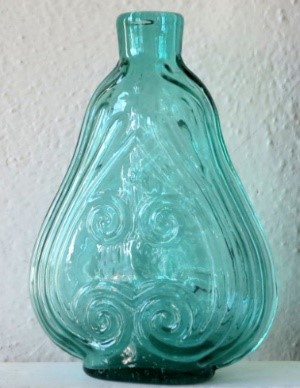
(9” high; green in color; contains a small amount of ancient tea.)
I found this typewritten story among my grandmothers papers. My notes are in italic.My grandmother (born 1908) wrote: This is the story as my grandmother (born 1860) told it to me:- “This bottle was given to me by my great-grandmother (born 1795). It was given to her by her son, William (born about 1812), just before they went West, and she never saw him again. She used it for her tea bottle. This is the very tea she put in it with her very own fingers. Will was traveling by covered wagon with his wife, two little daughters, and his best friend. One day (in 1846), somewhere in the wilds of Kansas, Will and his friend went hunting. After they had been gone all day, and it was beginning to get dark, Will’s wife was becoming worried about them. She heard a shot, and quite some time later, the friend came back to the wagon and said: “Has Will come in yet? We separated to hunt, decided on a meeting place, but I’ve waited a long time and he hasn’t shown up yet. I even shot off my gun once, but he didn’t answer” She anxiously told him that she hadn’t seen Will, so he searched and fired his gun all night long looking for Will, but no Will could he find, – or so he said. So, there was nothing to do, after waiting a week, but go on without Will. Will’s wife, not knowing what else to do, purchased a boarding house in the first town she came to. About a year later she married the friend, and about a year after that, the friend became very ill, and realized that he was dying, so he told her that he had shot Will, so he could get her. He told her exactly where he had hidden Will. After the friend’s death, a search party went out, and sure enough, there were Will’s bones under a sort of a little bridge.”
Antebellum Scrolled Violin Flask
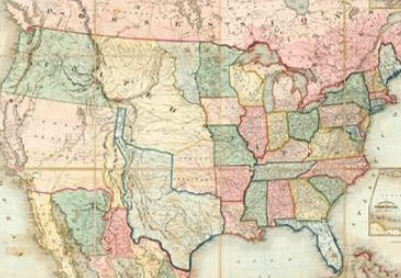
QUESTIONS: Where did this family live in 1846? What did “West” mean in 1846 What were the boundaries of Kansas? What town did they stop in? Where was Will’s body found? What was the murderer’s name?
Things I know: William Coleman 1814?-1846
His parents: William Coleman b. 1791; Armstrong County, PA d. 28 Oct 1846; Oregon City, Ogle, IL
married Martha Copper b. 1795;
1850 census Whiteside County, Illinois 1860 census Hamilton Township, Hamilton County, Iowa 1880 census Edison, Furnas County, Nebraska
d. 1884;
Other children: John Coleman 1812-1897 (died at Webster City, Hamilton, Iowa) Sarah Coleman 1815-1910 married William Russell Charlet Coleman married Tom Stricker Izzie Coleman married Levi R. Olmstead
US map 1850’s
COLABORATION: Have you heard this same story in your family? Let’s put the pieces together!
PS/ What have you written for your great great grandchild to discover? Who knows maybe future technology will make it easier to unravel a family mystery.
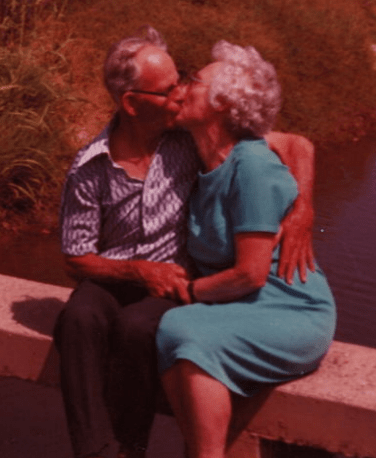
We drove down a dusty road, slowing several times before finding the “right spot.” There it was, the canal headgate where they were engaged more than 50 years ago.
It was during the 50th Anniversary weekend celebration in 1981 that we took the drive. They got out of the car and to my surprise they walked out onto the cement crossing and sat down right there with the canal water underfoot. At the time, she was 73 years old and he was 75. I guess being there made them feel young again, for it was right there where he had asked for her hand in marriage.
I treasure hearing the story and I giggled as he pulled her close and gave her a smooch. I didn’t often see that kind of physical display of affection from my grandparents.
She described in detail how she was working as a teacher, he was a farmer. They met at church. Her father walked her down the aisle, it was perfect. Musical selections included “At Dawning,” and the Lohengren’s Wedding March. The popular song “I Love You Truly” summarized how they felt that day and through the years as they raised two children and five grandchildren.
They were married 30 Aug 1931, the local newspaper had a lengthy description of their autumn wedding “Golden glow and autumn foliage, carrying out a beautiful yellow and green color scheme, decorated the church for the elaborate occasion. The church was crowded to capacity by friends and relatives, including many out of town guests.The bride was very attractively gowned in a white silk crepe. She wore a veil to match and carried pink rose buds.”
They enjoyed 62 years together before her passing. When I asked them the secret of a long marriage she said “marry your best friend.”
I have intentionally omitted names so that perhaps this will give you some ideas to ask your parents or grandparents about their love story.
A baby recently joined our family. A perfect little human! Nowadays, the hospital provided the parents with a form to fill out to receive the child’s birth certificate and social security number. In most states you can click Vital Records online and receive a copy of your birth certificate. It hasn’t always been like that.
Indeed a record of birth is one of the most important genealogical facts. Generally birth records give the child’s name, sex, date and place of birth and the names of the parents.
There are MANY birth index records online (paid sites) and a few states who have free indexes including: Arizona, Minnesota, Oklahoma, South Dakota. The dates vary but worth a look!
As a historian I have learned that before 1900 it was not mandatory to report a birth to the State. Sometimes Doctors or midwives kept a journal and they are treasures. Sometimes a newspaper reported the birth. But how can you find record of birth in other ways?
Here are some other ideas of where to gain information about a birth: Family members Hospital delivery record Newspaper birth announcement Hospital birth certificate with baby’s footprints Midwife Journal Doctor Records Church baptismal certificate Church newsletter announcements Adoption Decree School Records Family bibles City and county registrations Death records Marriage records Census records some years had the month and year of birth Census mortality records (1850, 1860, 1870, 1880) Obituaries Cemetery records / gravestones Funeral home records Emigration and immigration records Military records Probate records Land and property records Social Security Administration Records City Directory may list children and year of birth Find A Grave.com Civil War, WWI and WWII Draft Registration Cards Passport Wills
Oh that reminds me I need to go add the new person in our family to all my family records! What joy!
Happy Holidays – I wanted to share my favorite Christmas poem. My family always reads this on Christmas Eve. But have you thought about your family Christmas letter – does it give clues for future genealogist? Give this some thought.
“’Twas The Night Before Christmas” ‘Twas the night before Christmas, when all through the house not a creature was stirring, not even a mouse. The stockings were hung by the chimney with care, in hopes that St. Nicholas soon would be there. Genealogy Clues: It’s Christmas eve, there were no rodents, this home was well built and insulated, they believed in Santa and the stockings were hung!
The children were nestled all snug in their beds, while visions of sugar plums danced in their heads. And Mama in her ‘kerchief, and I in my cap, had just settled our brains for a long winter’s nap. Clues: Children had their own beds (would be nice to know their names), parents slept with caps to keep their head warm.
When out on the roof there arose such a clatter, I sprang from my bed to see what was the matter. Away to the window I flew like a flash, tore open the shutter, and threw up the sash. Clues: There will likely be a story in the paper the next day about the “clatter,” the home had shutters – for storms or coastal weather.
The moon on the breast of the new-fallen snow gave the lustre of midday to objects below, when, what to my wondering eyes should appear, but a miniature sleigh and eight tiny reindeer. Clues: Full moon, it’s winter time of year, recent snow, wife must be a heavy sleeper because she didn’t wake up.
With a little old driver, so lively and quick, I knew in a moment it must be St. Nick. More rapid than eagles, his coursers they came, and he whistled and shouted and called them by name: “Now Dasher! Now Dancer! Now, Prancer and Vixen! On, Comet! On, Cupid! On, Donner and Blitzen! To the top of the porch! To the top of the wall! Now dash away! Dash away! Dash away all!”
As dry leaves that before the wild hurricane fly, when they meet with an obstacle, mount to the sky so up to the house-top the coursers they flew, with the sleigh full of toys, and St. Nicholas too.
And then, in a twinkling, I heard on the roof the prancing and pawing of each little hoof. As I drew in my head and was turning around, down the chimney St. Nicholas came with a bound. Clues: they had a good roof and a chimney!
He was dressed all in fur, from his head to his foot, and his clothes were all tarnished with ashes and soot. A bundle of toys he had flung on his back, and he looked like a peddler just opening his pack.
His eyes–how they twinkled! His dimples, how merry!
His cheeks were like roses, his nose like a cherry! His droll little mouth was drawn up like a bow, and the beard on his chin was as white as the snow. The stump of a pipe he held tight in his teeth, and the smoke it encircled his head like a wreath. He had a broad face and a little round belly, that shook when he laughed, like a bowl full of jelly. DNA will verify he had twinkly eyes, dimples and his cheek like roses, his nose like a cherry. His droll little mouth, and beard.
He was chubby and plump, a right jolly old elf, and I laughed when I saw him, in spite of myself. A wink of his eye and a twist of his head soon gave me to know I had nothing to dread. Clues: Santa had a good disposition. A man of few words.
He spoke not a word, but went straight to his work, and filled all the stockings, then turned with a jerk. And laying his finger aside of his nose, and giving a nod, up the chimney he rose. Clues: Santa likes to work alone.
He sprang to his sleigh, to his team gave a whistle, And away they all flew like the down of a thistle. But I heard him exclaim, ‘ere he drove out of sight, “Merry Christmas to all, and to all a good night!”
What clues are you sharing in your Holiday Letter? What other clues do you read into this story?
What we wish for: Dates, places, names, details, stories, events, thoughts and feelings.
What’s next after the Christmas letter: Check the city directory or phone book. Check for Birth records for children. Census records for a husband, wife and children. Check land records for the purchase of their home. Encourage Santa to join a gym and stop smoking.
As I write this, it is Veteran’s Day 2020, I want to share my appreciation to all who serve and those who have served. As I explore my own family members who have served in the past, one story jumps out at me. One great great grandfather served in the lesser-known “Spanish American War.”
The Spanish American War started April 25, 1898 and lasted until August 13, 1898. The ten-week conflict was between Spain and the US due to worsening socio-economic and military position of Spain after the Peninsular War.
My great great grandfather, Frederick William English, enlisted in the Navy, North Atlantic Fleet at Detroit, Michigan with the rank of Private Landsman. When the “Spanish Conflict” began he was involved.
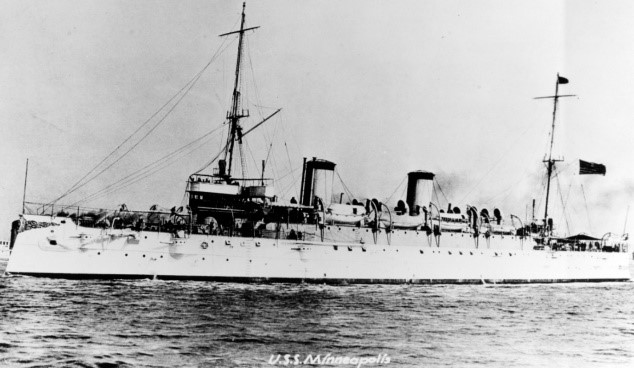
Information from Navy Records Frederick William English enlisted in the navy August 13, 1896, at Detroit, Michigan, to serve three years, as landsman. Born in Ripon, Wisconsin, February 2, 1872; occupation, laborer; height 5’10”; eyes, blue; hair, black; complexion, ruddy; “Lou” r.f.a; scar left big toe and below right knee. Served as followed” “Michigan” to Mar. 25, 1898 “Minneapolis” to Aug. 20, 1898 “Yosemite” to Nov 7, 1898 “Richmond” to Nov 14, 1898 “Dixie” to Mar 7, 1899 “Vermont” to Mar 8, 1899 “Newark” to Sep 12, 1899 “Franklin” to Sep 18, 1899 When discharged, expiration of enlistment. Rating changed to ordinary seaman, May 5, 1897. The file also included a detailed medical history. “June 5, 1899, Contusion, Right thigh, leg and ankle. Origin duty hit by falling tree while cutting wood for ship.” He suffered with leg and knee pain for the rest of his life. The pension papers were filled out by my ancestor including a detailed questionnaire. When, where married, a copy of the marriage certificate. Names and dates of birth of all children. Description about his health and accidents while in service. And his signature!
You may be thinking how would I learn about my ancestor and their service record.
To begin you can check with your family member and record the “stories” they know. Record all places and dates as they know them.
Military personnel records are open to the public 62 years after they leave the military.
National Personnel Records Center Military Personnel Records 1 Archives Drive St. Louis, MO 63138 PHONE: 314-801-0800*
Most records are free. *Due to covid-19 the Customer Service Line is sometimes unstaffed.
Once you have established what unit your ancestor served in you can search that specific until for clues.
Preparations for the Spanish American conflict started in October 1897 with the main issue being Cuban Independence from Spain. President McKinley resisted the idea of war but finally on April 11, 1898 he asked Congress for authority to send American troops to Cuba and on April 25th that year, the Spanish American War was declared. It would be one of only 5 American wars to have been formally declared by Congress. And it would be one of the shortest wars in history, lasting just 3 months, 2 weeks and 4 days.
Aboard the ship USS Michigan in 1898, my ancestor patrolled up and down the Atlantic Coast while heavy fighting was taking place in and around Cuba.
Frederick was serving on the SS Minneapolis at the time the war officially ended but peace-keeping activities would continue on the Atlantic Coast and the Gulf of Mexico.
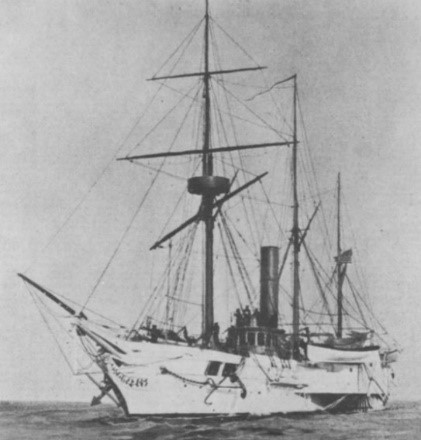
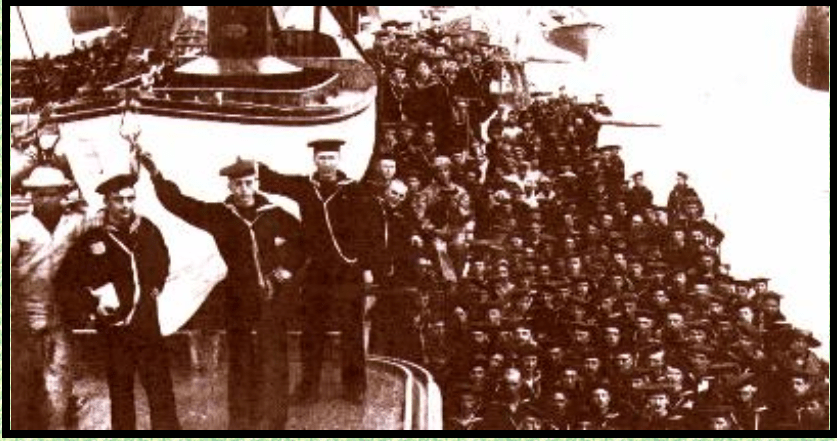
Aug 13, 1898 – Over the next 7 months Frederick served on the SS Yosemite
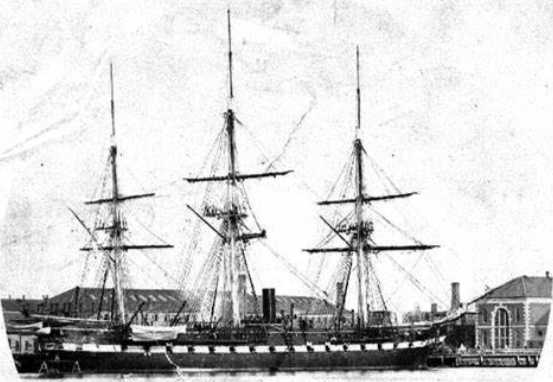
Picture of the Yosemite and crew, wouldn’t it be awesome if that was your ancestor.
The next vessel is the SS Richmond
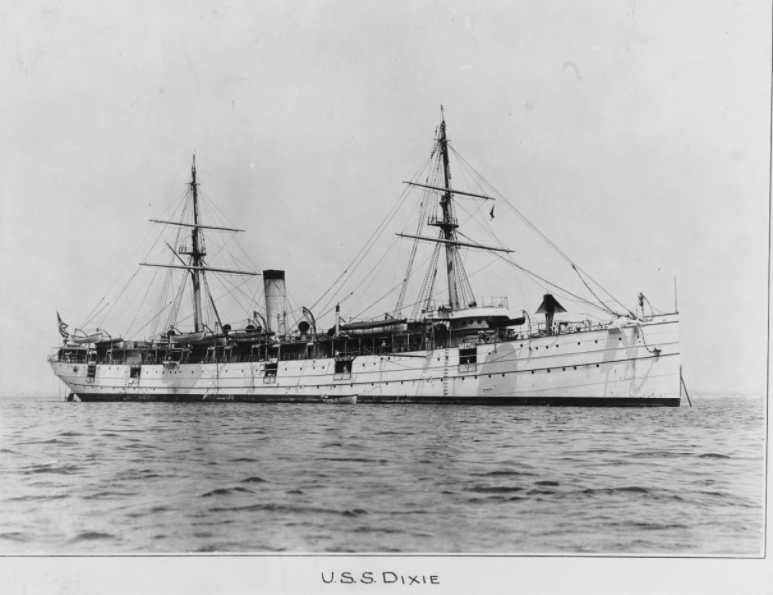
And then the SS Dixie to Mar 7, 1899
and the SS Vermont to Mar 8, 1899.
On March 9, 1899 Frederick transferred to the SS Newark. By that time the conflict was called the Philippine-American War.
Aboard the Newark, Frederick made the trip down the eastern coast of South America on patrol, stopping at numerous ports along the way. His heavy wool uniform became increasingly uncomfortable as the climate warmed. Reports state the temperature was high (108 degrees) and high humidity. The men slept on deck when possible, but there were bugs, irritating bugs.
By April 7 the ship sailed through the Straights of Magellan and headed north towards San Francisco. The ship became low on coal and was forced to put into Lowe Bay, Chili, just north of the Magellan Straights where the sailors were required to cut wood for fuel. It was while on shore cutting wood that a tree fell on Frederick causing a serious contusion of his right thigh, leg and ankle. He was admitted to sick bay for 8 days. On arrival in San Francisco in September of 1899 he would transfer to the USS Franklin
The USS Franklin provided his transport back to Norfolk, Virginia for discharge after serving 3 years in the Navy.
April 25, 1898 The U.S. Congress declares war on Spain.
May 1, 1898 First major battle between Spanish and U.S. Forces: U.S. Commodore Dewey and his Asiatic squadron defeat the Spanish fleet at Manila Bay in the Philippines.
June 22, 1898 U.S. troops land in Cuba.
July 1, 1898 U.S. forces defeat the Spanish at the Battle of San Juan Heights.
July 3, 1898 U.S. forces destroy the Spanish Fleet off Santiago Bay, Cuba.
July 17, 1898 The Spanish surrender at Santiago.
August 12, 1898 The U.S. and Spain sign the Protocol of Peace, ending hostilities between the two countries.
December 10, 1898 The Treaty of Paris is signed by representatives from the U.S. and Spain, ending the Spanish-American War.
February 6, 1899 The Treaty of Paris is ratified by the U.S. Senate. Under the treaty, the U.S. acquires control over Cuba, Puerto Rico, Guam and the Philippines.
I find it so interesting to line up my ancestor’s service, the military timeline and resources from newspapers. How will your history come alive?
Every once-and-in-while I stumble across an obscure find and think “no one would know to look here for that.” Usually I copy it or print it thinking “maybe someday I will share this, or someone will need it.” Even if it isn’t helpful for me, I can’t overlook unique, obscure records, can you?
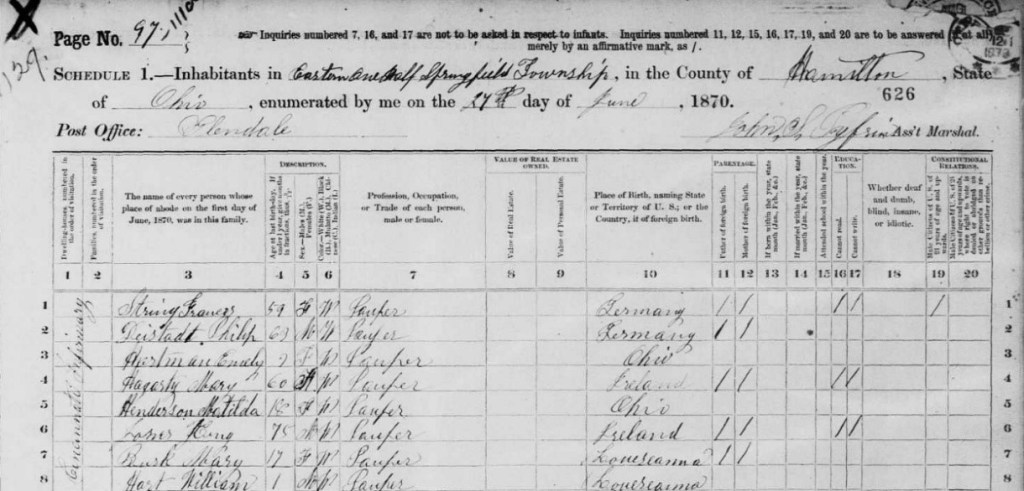
Here is an example. While searching for a friend recently I found his great-great grandfather in the 1870 Ohio Census. I discovered that he lived in the Cincinnati Infirmary. “Sick” I thought, “he must have been sick.” But as I did some research I realized the Cincinnati Infirmary was designed to help the poor. His occupation was “Pauper.”
1870 US Census, Eastern One-Half Springfield Township in the County of Hamilton, State of Ohio 24th June 1870 Post Office: Glendale Page 97, Line 2
Name Age Race Occupation Place of Birth Philip DIESTADT 69 white Pauper Deutschland
The 1870 census lists about 400 names at the Cincinnati Infirmary, including the Superintendent and Staff. Their place of births range from United States to Germany, Ireland, England and Switzerland. Residents ages ranged between 1 and 105. One can only imagine the circumstance that led folks to be housed here.
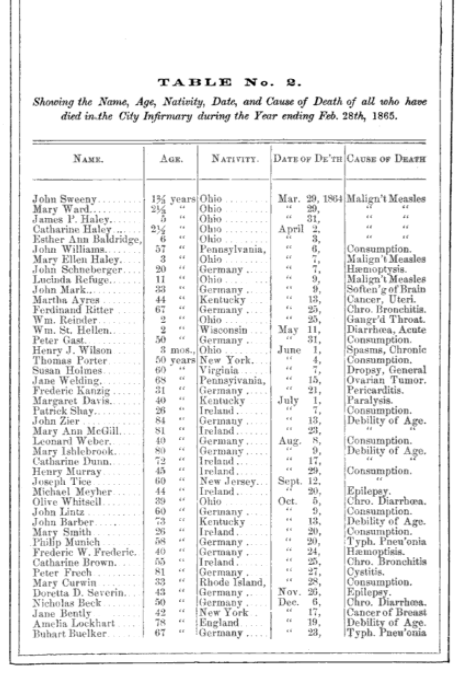
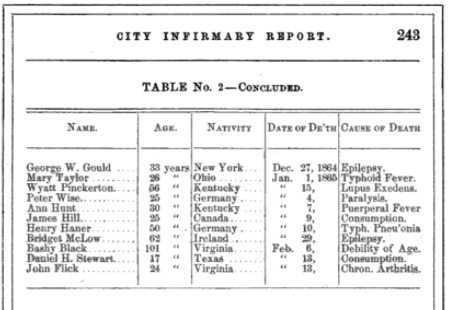
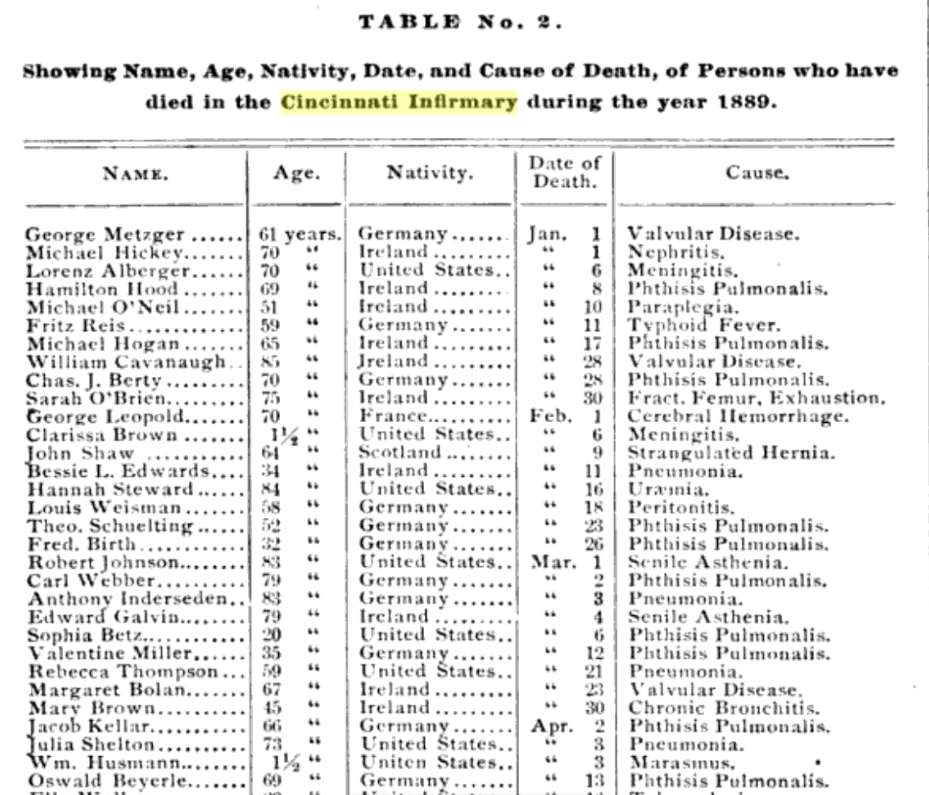
Upon further search I found a Google book that described the Cincinnati Infirmary. The Annual Report of the City Departments of the City of Cincinnati in 1865 posted a lengthy report and in Table 9 it listed the Name, Age, Nationality, Date, and Cause of death for all who died in the City Infirmary for the year ending Feb 28, 1865. [Annual Report of the City Departments of the City of Cincinnati. Page 242.]
Likely the names listed were not in a position to have a probate record, sale of land, or even an obituary in the local paper. So what a treasure to find this resource.
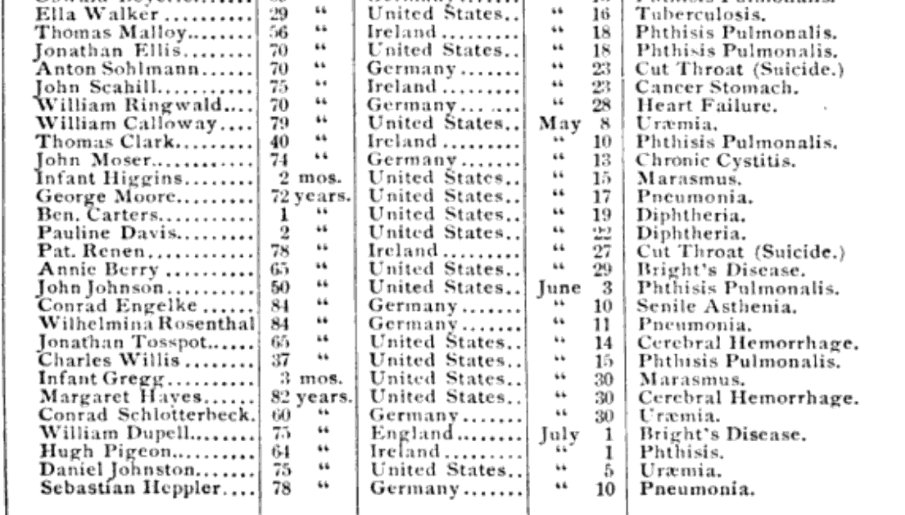
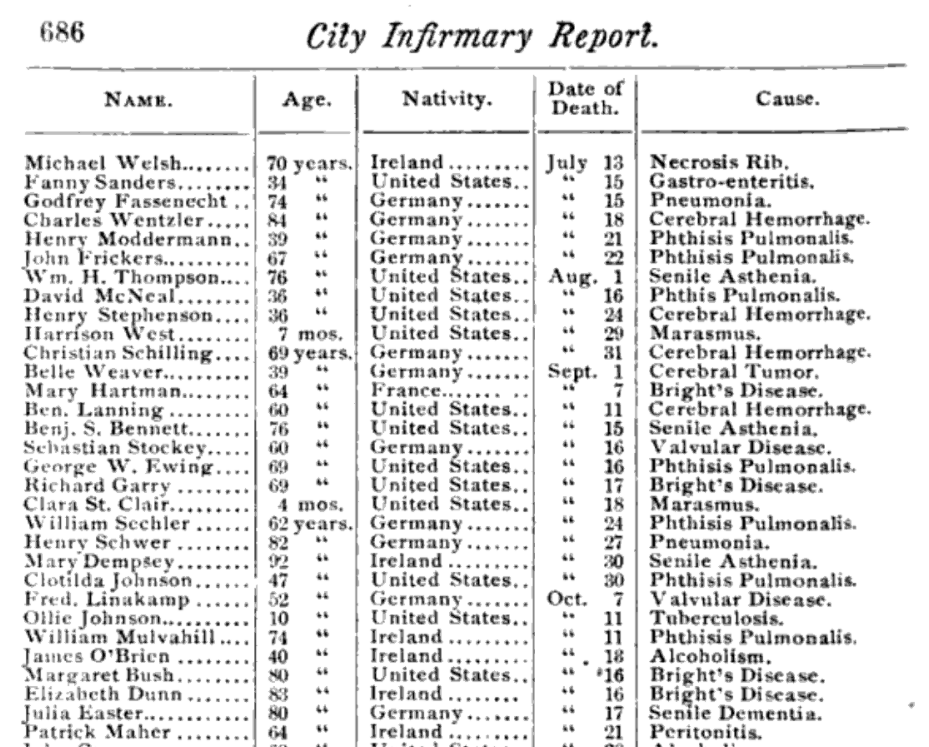
There is a similar list for the year 1889. I am attaching these lists in hopes that someone, somewhere will find the name of their obscure ancestor.
The City Infirmary was a municipal institution affording relief to both in-door and out-door paupers. The buildings, which are spacious and extensive, were located on the Carthage Road, 8 miles north of the city. It was situated on a farm belonging to the institution which contained 160 acres of beautifully rolling land. This position commands a fine view of the surrounding country. During the year ending 1873 large additions were made to the buildings, and there was a larger number of inmates than were ever before gathered within its walls. [Illustrated Cincinnati: A Pictural Handbook of the Queen City, By Daniel J. Kenny, p. 50]
In 1874, there were 330 patients admitted, and the cost of supporting each was 22 cents per day. The report states: lodgings and meals have been supplied to 616 “tramps,” or men on the road. 746 patients received medical treatment during the year. In the City Infirmary School there were 30 pupils and the farm and garden produced $12,403.28. [Representative Citizens, Volume 1, p. 1031]
Other tables include information such as the Ages of the Inmates Remaining, Mix of White, Black, Males and Females and a long list of “ailments they were admitted for.”
Often called the Poor House, the County Home, the Insane Asylum or the Infirmary, these places provided a safe place for folks in need. Sometimes home to abandoned children, the injured, the sick, and folks with hardships or illnesses. Maybe it was just misfortune – we can only wonder.
Here are a couple of links to other “List of Paupers” you may find useful.
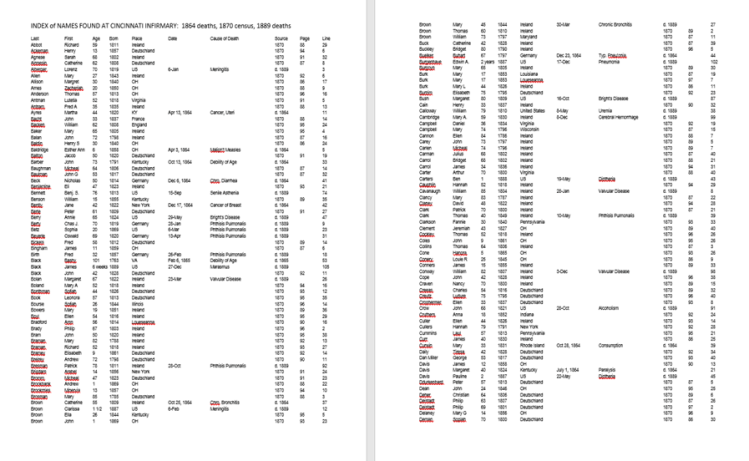
See below for the full index of all names found in the three records, 1864 deaths, 1870 census, 1889 deaths. Click on the link to download the file to be able to search.
It’s back to school time and it got me thinking how to encourage kids to enjoy their family history.
In my mind it’s never too early to start sharing family history with children. Often one of the first words a child says is “daddy” or “mommy.” That is the first step in understanding how your mother and father fit in your family tree. Before long they understand a sibling fits in and the grandparents and aunts and uncles too.
Start with what you know. Use a simple family tree chart to start.
Keep it simple. Start with one person, one generation at a time. What a thrill for a grandparent to be asked about their life ‘way back then.’
Talk with your family, aunts, uncles. Ask them questions about what they know about your family.
School age children may enjoy seeing their own certificates, birth, baptism or from the hospital. Show them marriage certificates and death certificates.
Junior high age students will enjoy a visit to local FamilySearch Center, the local library or history center. Staff will direct you to local and online resources.
Let the kids decide how you will preserve and store the items.
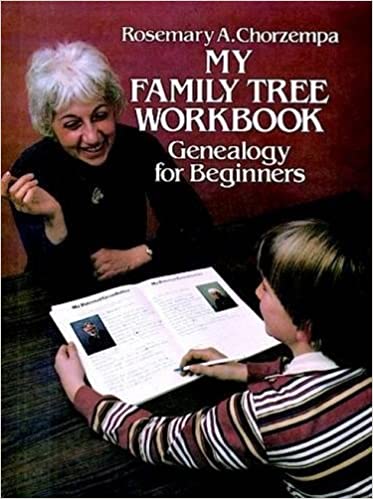
One great resource is “My Family Tree Workbook” (Dover Children’s Activity Books) by Rosemary Chrozempa.
Easily accessible to the youngest of historians, this volume assist in learning fundamental research principles and beginning the search.
This book has a “me” page. It starts with the child’s name, nickname, address and the date family history started.
I think it is neat that I started family history research early. I got interview all my aunts and uncles, and many of great aunts and uncles. What a treasure to hear their perspective of family history. I’ve learned much more since the internet and increased records being indexed, but I treasure those early cassette recordings and notes.
Have a child “draw” their family. Paying attention to their hair color, eye color and height. They can include as many or as few members as they wish.
How fun for a youngster to connect with a grandparent who played the same sport they play.
Perhaps you can find diaries written by other kids about a place your ancestors came from.
Maps are a good way to learn current and historical information.
Did you know there is a Boy Scout honor?
Cousins can make excellent penpals or ipals. Cousins share your grandparents.
Photos are fun ask your child – what can we learn from looking at a photo. Become detectives and look at the photo for dress, hair style, furniture, cars and other descriptive details.
There are many online puzzles and games. Make a Word Scramble or Word Search using your family names.
Fun ideas to do as a family: Create a time capsule, plan a Family Reunion
Another good book: Do People Grow on Family Trees? Genealogy for Kids & Other Beginners: the Official Ellis Island Handbook. By Ira Wolfman, Workman Pub 1991. 179 pages of interactive genealogical guide.
Let me know how your children respond to these ideas!
I’ve been asked to define the “value of an obituary.”
In my mind an obituary is the lasting, printed legacy of someone. It is the historical record that should last forever. Telling us the name, age, location, education, employment and survivors of someone who has passed.
Some have suggested you plan ahead and write your own obituary, I think that is a great idea. It is not narcissism, it is taking hold of your life story. It is not morbid, we all know that’s how the story turns out.
So would you consider writing your own obituary? Beyond the obvious use after your life, it’s a wonderful reflective process to consider where you came from and what you have accomplished in this life. What a blessing to your family who may be at a loss for words after your passing. Another value is accuracy, no one better than you to get the facts correct.
A few years back, I was in a situation where I had to accompany a friend to the funeral home after his mother died expectantly. The caring staff slipped a “form” in front of my friend whose eyes were full of tears.
“Fill this out,” they said. He began with her name, date of death, town she lived in, etc.… then the form asked about her birth, birthplace, her parents and their birth place. He slid the form back “I don’t know” he said. I grabbed the clip board back toward us – wait I said let’s see what we can figure out. I knew this information would be used in her obituary and perhaps her death certificate.
After some research online we found some info to include. Her birth was recorded in the California birth index (Ancestry), her graduating high school class was noted (Classmates), her marriage was posted in the newspaper (Newspapers), and her mother and father’s obituaries (state historical society) yielded much needed information.
Printed obituaries trace back to the 1700’s. Today more than 6,000 US newspapers and many online sources post death notices. For a fee anyone can have a descriptive obituary, right along with the obituaries of the rich and famous.
There are many online sites with info about how to write your own obituary. For some it’s easy to sit and tell the story or recite the facts. It will be unique for each person. Perhaps you should read some obits in the paper now, do some of them tug on your heart strings? Why?
Be Pandemic Prepared
There has never been a better time to consider this project – due to the Pandemic which has recently taken so many loved ones. An interesting obituary project related to COVID-19 is the New York Times’ “Those We’ve Lost.” This aggressive project attempts to put names and faces to the numbers who have lost their life due to the virus.
A coworker once told me she got her Journalism/Marketing career started by “writing obituaries for the local paper.” She was determined to make ‘em readable!
Really it’s our “Origin Story” – and the long or short of it is a “boy (or girl) makes good opportunity.” Telling the tale of a persons origins, education, education, hardships and successes and survivors.
Now in its second season, Rocca shares informative, and often humorous obituaries. Rocca stated “A good obituary should be like a trailer for an Oscar-winning movie – there should be highs, lows, triumphs and tragedies.”
If you are writing notes for your loved ones to use, perhaps you want to tell them what inspired your life? Did you survive a catastrophe? What words do you think describe you? Do you have a charity or cause that is important to you?
When writing your own story be sure to include: full legal name, marriages, career, family. Include nicknames, place of passing, place of residence, education, employment, high school, college, degrees and survivors.
SOCIAL MEDIA
In our modern world we often learn of the passing of loved ones, friends or acquaintances through social media. If you are writing the post of someone’s passing, I encourage you to keep in mind that family, close loved ones, friends may not know what you know. Avoid being cryptic and confusing. Avoid over-sharing until the family has a chance to share the information. There is no rush, take a breath and consider your words carefully before you post.
In researching for this blog, I was surprised to learn of the multiple online obituary sites where you can post the obituary of a loved one. Sometimes for free, sometimes for a fee. (And of course as a researcher you can find someone you’re seeking.) Do remember that when you type in the name of someone who has passed you might receive 28,900,000 results – so hopefully the obituary has something interesting and unique in it … so they can be found for all time into the future!
As a reminder you can learn more about a person from asking family, friends, coworkers, church pastor, volunteer groups, photo albums, scrap books, online and libraries.
Having someone else proof-read the obituary is a good idea to ensure an accurate announcement of passing and a forever record of a life.
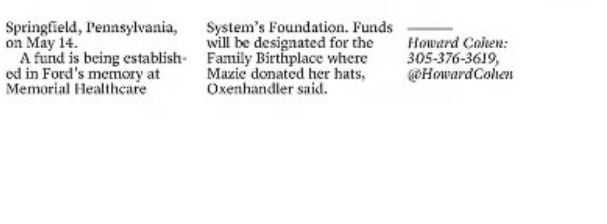
I wouldn’t want you to end up like Mrs. Philena Walker who at her death was the oldest person who was born in town and yet they could find no more than 7 lines of text to describe her life. [Aurora of the Valley (Newbury, Vermont) 02 Jul 1870, Sat, pg 4]
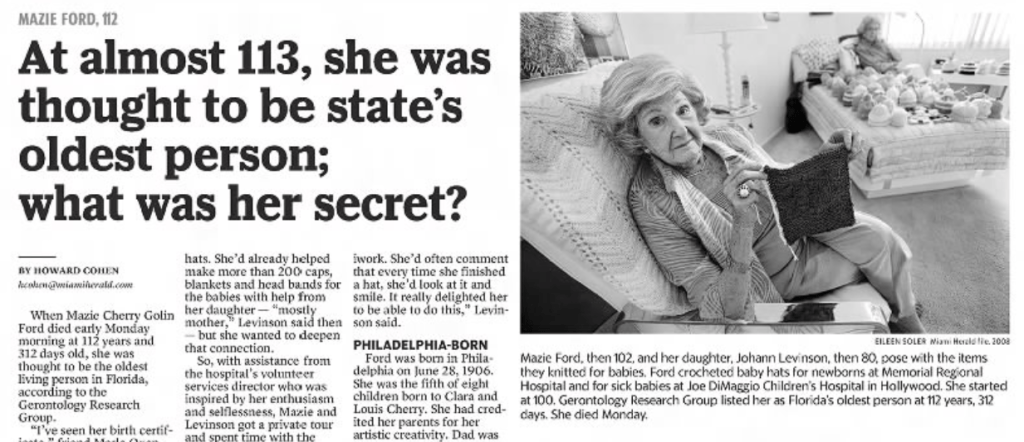
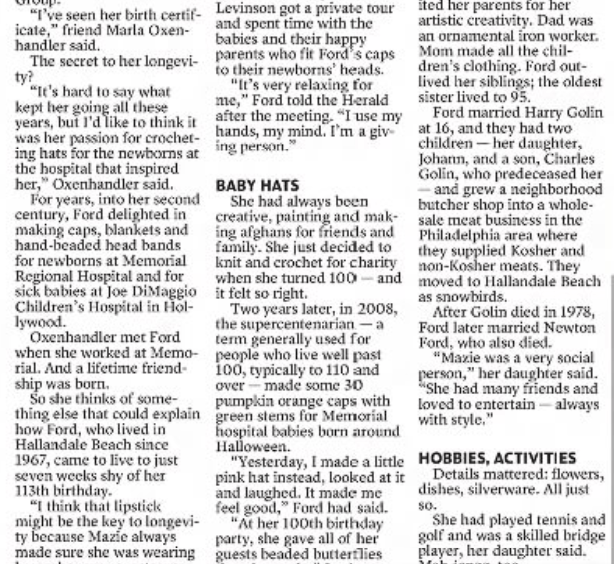
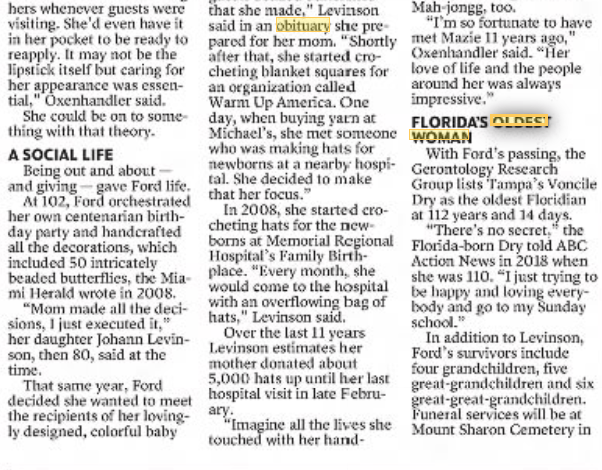
Better to be like Mazie Ford, 112, with a photo and 3 full columns of life history. [Miami Herald (Miami, Florida) 09 May 2019, Thu, Page A8]
PS/ It’s a joke in my family to read the obituaries in paper “and see if I am in there.” ‘Til then I’m available to discuss your family history questions.
Have you been to the doctor’s office and wonder why it matters whether or not your grandmother had high blood pressure or diabetes? According to WebMD “These details about your family health are vital to doctors because some diseases run in families.”
The online Mayo Clinic states that Doctors use genetic medical information to:
Assess your risk of certain diseases
Recommend changes in diet or other lifestyle habits to reduce the risk of disease.
Recommend medications or treatments to reduce the risk of disease
Determine which diagnostic tests to order
Determine the type and frequency of screening tests
Identify a condition that might not otherwise be considered
Assess your risk of passing conditions on to your children.
Illnesses that may have a genetic component include: Cancer, Heart disease, Diabetes, High blood pressure, High cholesterol and Stroke.
Medical history is vitally important for your doctor to know what you are at risk for and often family medical history is challenging to find. But do not give up hope, here are some resources that might be helpful. And be sure to start recording your medial history now for future generations!
Sources of Medical History
You might find these at Home
Church Bulletins – sometimes announcements about illnesses are included in the requests for prayer.
Correspondence – someone may have written about an illness, or asked how someone was doing who was sick.
Diary/Journal – often people record information about their illnesses or the condition of others.
Family Bibles – people often recorded information about illnesses and deaths in their Bible.
Family Tradition – maybe someone recalls that uncle Fred had TB?
Life Insurance Records – this would be a gold mine to know what was included in application, or payout of life insurance.
Photos – sometimes photos may reveal visible disabilities or pictures of a funeral/burial.
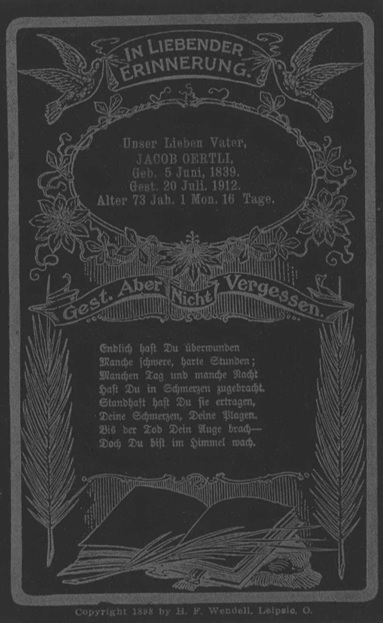
Funeral Cards – these were very popular in the early 1900’s
Example: Funeral Card for Our Dear Father – Jacob Oertli 05 Jun 1839 – 20 Jul 1912
Records you may need to write for
Burial Records – each cemetery recorded the purchase of burial plots and each person buried there.
Civil Records – could there be legal papers filed in the county related to your relatives death? Was the death an accident?
Online Records
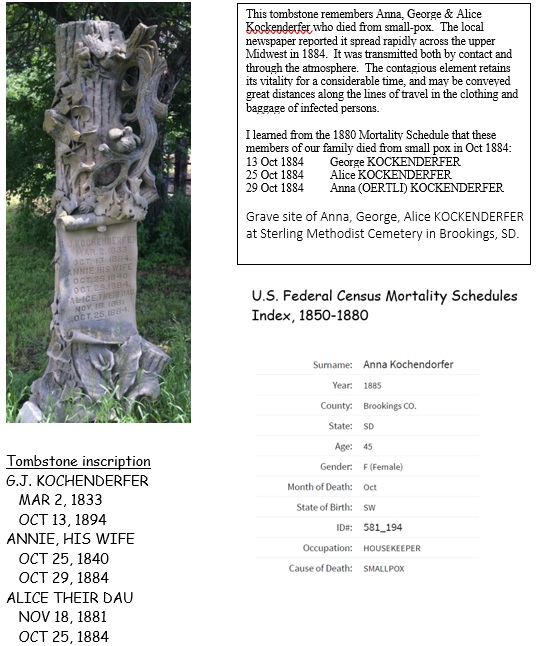
Cemetery Records – often cemeteries have excellent records of people buried there. FindAGrave.Com is a start! I found this amazing tombstone on Find A Grave. It lead to information about how small-pox affected our family at one time.
US Federal Mortality Schedules Index (1850-1880) varies by state
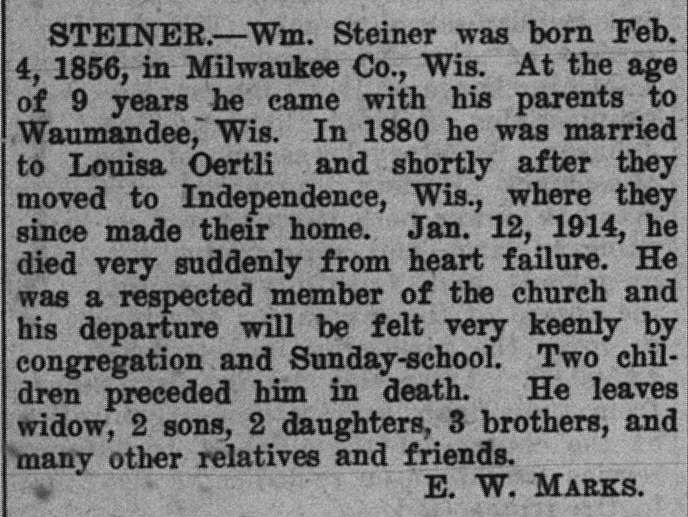
Church Records – As seen in this church newsletter obituary:
This example is William Steiner’s obituary stating he died suddenly from heart failure. Source: The Evangelical Messenger – Church paper for the Evangelical Association. Index is available online at https://www.genealogycenter.info/search_evanmessenger.php
Death Indexes – many states now have death indexes online
Employment records (Railroad) – may describe death and cause
Death Certificate – most states began requiring death certificates around 1900.
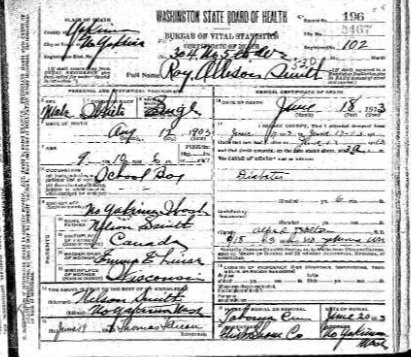
Example is a Washington State Death Certificate for ROY ALLISON SMITH who died June 18, 1913 – Cause of death: DIABETES
Find At A Library
County Histories – some histories give detailed accounts of a persons life.
Family Histories – privately published family histories often share information about a persons death.
Cemetery/Funeral Home
Guardianships – if a person died with young children there could be detailed guardianship papers filed with the county.
Hospital Records – if a person died at a hospital, it would record the details, IF you could get copies.
Mortuary Records – The business that handles the body after death will have detailed information including biographical and personal information.
Cemetery Record – The cemetery where a person is buried will have records of who is paid.
Example: St. John’s Cemetery Book, Waterloo, Ontario, Canada. States Valentin Schlegel died 30 Jun 1863 of complication of Asthma.
Online Newspapers
Newspaper clippings – these can be full of useful information
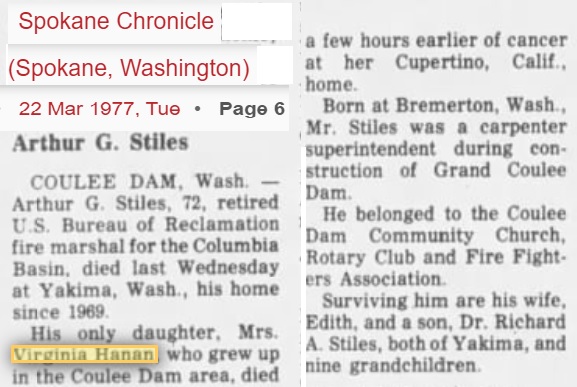
This example describes Arthur G. Stiles’ death on the same day as his daughter Virginia Hanan. Her cause of death: Cancer
Obituaries – many obituaries in newspapers are available online or by writing to a library.
Less Common Records
Coroner’s Record – a legal record of an autopsy report, they are available in some areas.
Pension Records – pension records may describe information about their death, particularly if they died in service.
Permit to Transport Deceased Persons – requirements vary but you can inquire with the funeral home and state regulations
Real Estate Records – a home may be sold due to a person passing.
Veterans Papers – pension records may describe information about their death, particularly if they died in service.
Wills/Probates – probates filed with the county may reveal details.
US Census Mortality Index (deaths within 12 months of a census) – these rare finds describe date, place and cause of death.
A family medical history can’t predict your future health. It only provides information about risk. Good luck as you ask your relatives, cousins and family historians. Let me know if you find something interesting in your family medical history. Or if you need help getting started.
There are some online tools to help you gather info, including this one from the Surgeon General and the CDC.
And remember you have a right to ask for your own medical records. You may need to pay for them, but think what a blessing that would be to future generations!
You might want to consider: Drug sensitivities, Chronic Conditions, Disabilities and Allergies.
PS/ Adoptees may want to contact the State Adoption Unit, Coordinating Agency, Hospital or their baby books – sometimes adoptive parents are told “non identifying facts which may include medical history.” You might also want to consider DNA genetic testing.
How many first cousins do you have? Most people have 4-6 first cousins. Those are your parents-siblings-children. You know your aunt and uncle’s kids. The ones you played with when you were a kid but kinda lost contact with except for at your grandparents funeral.
Ok let’s assume each family has 3 kids (we know way-back-when the families were WAY bigger) look at how our cousins list grows! And an example of 6 kids per family to boggle your mind. It’s amazing how fast our families grow when we consider this.
3 kids per family 6 kids per family 1st cousin 9 36 2nd cousin 27 216 3rd cousin 81 1,296 4th cousin 243 7,776 5th cousin 729 46,656 6th cousin 2,187 279,936 7th cousin 6,561 1,679,616
When God said go forth and multiply he wasn’t kidding.
Now, not all those cousins are alive in your life time, but if your family kept good records (like mine did) you have a chance to know your 1st, 2nd, 3rd cousins. And now with DNA test results I have made connections with 7th cousins!!!!
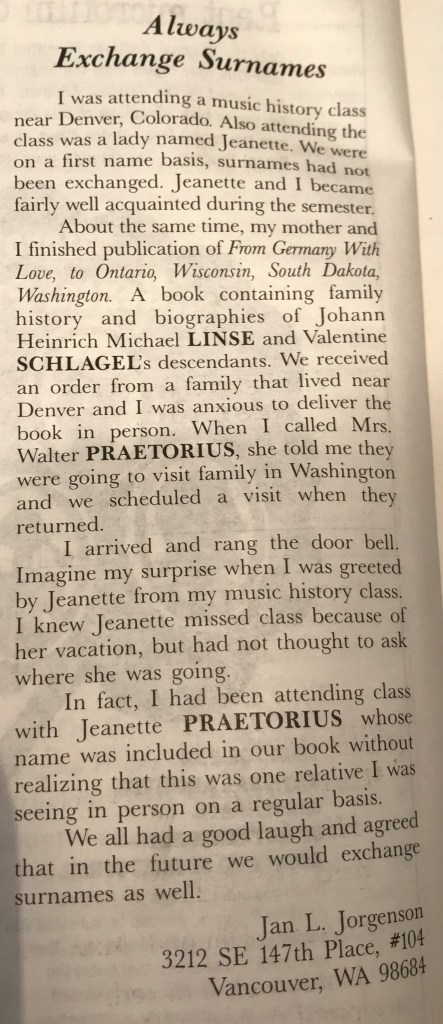
Long ago, I learned a lesson about cousins. Originally from the Pacific Northwest I spent one year in Denver, Colorado. I attended a music history class at a local community college. The story is published in the July/August 1990 Genealogical Helper.
My Cousin, Jeanette hadn’t always lived in Denver either. We were both so surprised our paths crossed there. While The Genealogy Helper Magazine is no longer being published you can find an index to some years on MyHeritage.
So, you’re guessing you have cousins by the dozens who you want to get to know or you think may have genealogical information that you don’t. Here are some tips:
Ask the cousins you do know.
Read the obituaries of your great grandparents looking for names listed.
Research on line.
Contact your local genealogy society.
What a small world it is. I bet you have a relative living your town and you didn’t even know it. That makes a good reminder to treat everyone like your cousin, it is basically a good way to treat all people. After all what the world needs now is love, more love and kindness.
Here is one example of how to find family history information about your people. I know my family lived in Waumandee, Buffalo County, Wisconsin so let’s look at Buffalo County Online. bchsonline.com/web/family-history-list/
The Buffalo County Historical Society has many resources available for viewing in our office. You can look at newspapers or Buffalo County Census Records on microfilm. We also have many family histories on file.
From their webpage – Family History List
THE FOLLOWING IS A LIST OF FAMILY HISTORIES THAT HAVE BEEN COLLECTED IN THE BUFFALO COUNTY HISTORICAL SOCIETY OFFICE. THESE HISTORIES RANGE FROM SHORT NEWS ARTICLES TO PROFESSIONALLY PUBLISHED BOOKS.
There are hundreds of books and documents listed – here are the ones related to MY family tree.
Double Cousins By the Dozens; by Roger M. Goetz, (1982), names: Heck-Heike, Horn, Kuehn, Lauterbach, Linse, Otto, Pfund, Richter, Rick, Schultz, and Steinke primarily of Buffalo and LaCrosse Counties
Linse-Schlegel/Schlagel from Germany With Love To…Ontario, Wisconsin, South Dakota, and Washington; by Bette Schlagel Rogers and Jan L. Rogers Jorgenson, (June 1984), names: Linse-Schlegel/Schlagel
Oral History Interview with Lois Linse Gleiter; by Dale E. Treleven, (1974), names: Gleiter
Events of My Life. Born February 14, 1913 To ?; by Hilbert George Michael Kochenderfer, names: Kochenderfer
Kochenderfer House “Oldest Building in County Nominee”; names: Kochenderfer
Excerpts from Trempealeau and Buffalo County Papers in doing Family History and Helping Others; by Millicent A. Hild, (January 1997), names: Faulds, Luetscher, Buehler, Ristow, Saxer, Muhleisen, Genealogy in Buffalo and Trempealeau counties of the authors own families.
Johannes STEINER Family in Wisconsin (1846-1996); by Mary Anne Falk, (August 1996), names: Steiner
Leonard and Katherine Hardt Blank Descendants; by Alethea Blank Keller, (2002), names: Blank
Note: The Buffalo County Historical Society also can do genealogy research for you for a fee! The research rates are $10.00/hr if you are a current member of the society and $15.00/hr if you are not a member (there is a one hour minimum). We also charge $0.50/copy for the first 10 copies made and $0.25/copy for each copy after that as well as postage. If you would like to have some research done, please contact us by e-mail or you can send your check or money order with your request to: BCHS, PO Box 394, Alma, WI 54610.
If you’d like my help finding your cousins, drop me a line! And, of course, once you have your story written up share it with your local genealogy library for others to learn from!









 Geneographer
