
Searching historical records for a relative who was a North Dakota farmer can be a challenge. The reasons include #1 Limited public records, #2 Many Scandinavian names are similar, such as Olson, Olsen, Oleson, Olsson, #3 Shorter life span due to hazards.
Thankfully we have the 1900 federal census as a place to start!
The 1900 United States Census was conducted on June 1, 1900. There were 76,212,168 persons enumerated (counted) in the United States.
Questions asked and recorded include:
Address, name, relationship to head of family,
Sex, race, age, month and year born
Marital status and, if married number of years married.
For women, number of children born and number now living.
Place of birth of person, and their parents
If foreign born, year of immigration and when naturalized
Occupation
Months not employed
Attended school
Ability to speak English
Whether on a farm, farmer
Home owned or rented, and, if owned, whether mortgaged
There were 319,146 people living in North Dakota in 1900. Some tips for successfully searching census’ include:
· remember names had variations, often people used initials.
· Enumerators wrote what they heard, they had poor penmanship.
· sometimes they missed people in the index so don’t be afraid to read for yourself.
· knowing where your ancestor lived is important, learning about their neighbors might reveal relatives, friends.
If you slow down long enough the answers are there, or not there.
It’s like asking your ancestor “what was your occupation?”, Did you attend school that year? Could you read or write, speak English?
A blank line may mean as much as a filled in one. Example: did they did not own their home, whether they lived in a home or on a farm, was the home mortgaged.
Where can you find the census records?
Many libraries offer these inhouse for free. Or subscribe!
· FamilySearch.org
· Ancestry.com
· National Archives
· Fold3.com
· My Heritage
· Do a google search for your county and year sometimes they have been typed in by a local genealogist.
For 230 years the US has captured Census data every ten years. There is a 72-year privacy period meaning this 2020 census will be available in 2092. Just think of that in the future your descendants and relatives maybe looking for you! (Sadly, the 1890 census was lost in a fire.)
In the beginning of my research days I was so excited to find names and ages, I hurried through some of the closer-look-details. I now realize the Census reveals personal information as well as migration information, often families followed friends to a new location.
Did your family include a woman working “before her time.” Was she widowed, single, or abandoned?
Take a moment and imagine what was it like for that family to gather around the dinner table. How many, what ages, what languages, what stories were told from work or school. Perhaps you can get a sense of the family economy. Working or unemployed. Living in a city or rural.
By 1910 census they were asking when the person immigrated and had they been naturalized or applied for first papers. You can learn if your family suffered child mortality.
The 1930 census asked about Rent, Radios and Relocation – more about that another time.
Here is an example – I will explore several sources to learn about Charles Olsen who lived in rural North Dakota. Here he is in the 1900 census.
1910 North Dakota, Barnes, Rosebud, District 0013

Name Age married children birthplace arrived in US, naturalized, occupation.
Charles Olson 50 m 24 Norway Norwegian 1881 Na Farmer
Julia Olson 42 m 24 10/8 Iowa
Carolina Olson 17 MN
Alma Olson 14 ND
Henrietta Olson 11 ND
Carl Olson 8 ND
Adolph Olson 5 ND
Edna Olson 2 ND
From this record we can note the obvious – names and ages. But behind that we learn about their migration pattern. The father born in Norway. The daughter Carolina age 17 was born in Minnesota and the 14 year old was born in North Dakota.
I found Charles Olsen in the Bureau of Land Management records also:
https://glorecords.blm.gov/default.aspx
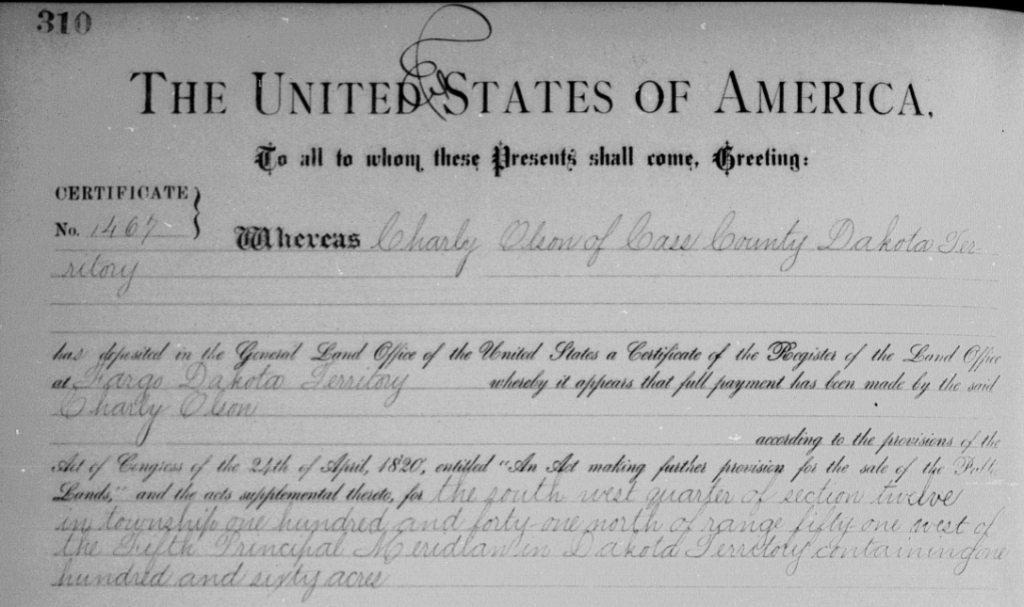
This record discloses a description of the property as well as the name of the purchaser:
OLSON, CHARLY 6/30/1882 ND 4th PM Twp 141N R 051W SW 1/4 Sec 12 Cass County.
Then the Naturalization Index https://library.ndsu.edu/db/naturalization/
Olson Charles Norway 2nd Papers December 22, 1892 Barnes Volume F015 P392
Another source available for rural North Dakota is Church records (including membership and baptismal). This example found at Ancestry.com. These can be a gold mine!
U.S., Evangelical Lutheran Church in America Church Records, 1781-1969

Alma Emelia Olsen 7 Juli 1895 Charles Olsen, Julia Olsen
Hilda Berthine Olsen 26 Sep 1889 20 Oct 1889 St Thomas Church, Svea
Oskar Theodor Olson 21 Sep 1887 6 Nov 1887 St Thomas Svea
Hance Caroline 30 Apr 1893 bap 30 Dec 1892 Charles & Julia
Another great resource for rural areas is Find a Grave www.findagrave.com – Cemetery Index Not only did I find a grave stone photo, but someone had posted an obituary for Charles Olson!
Life’s Journey is Ended for Charles Olson
Funeral Services Held in Glenwood and at Valley City, N.D.
The life journey of Charles Olson Branby came to a peaceful end at the home of his son, Carl Olson, in Barsness Township on Wednesday, June 18. Death was due to the infirmities of old age. The life span of Mr. Olson began in Telemarken, Norway, where he was born on January 6, 1860. He was therefore, past 81 years of age at the time of his death. His parents were Ole O. and Tone Branby. At the age of twenty-one, he left the homeland to seek his fortune in the new world. He came to Pope county in July, 1881. On May 6, 1886, he was united in marriage to Julia Hougen at the parsonage of Rev. Skaar. Shortly after their marriage, he moved to his homestead, three miles north of Litchville, traveling in a covered wagon. He prospered in this new country and acquired considerable farm land, before he left for Pope county
again, twenty-three years ago. Mr. and Mrs. Olson took an active part in community life and were charter members of the first Norwegian Baptist Church near Litchville. In Pope county he acquired farm land, having sold his land in North Dakota. Funeral services were held from the Berry Funeral Home at two o’clock on Saturday, June 21st. The services were conducted by Rev. J. Linnevold. Funeral services were held at the First Baptist Church of Valley City, N.D., at two o’clock P.M. June 21st, Rev. F. H. Swanson officiating, and burial at St. Thomas cemetery near LItchville. Pallbearers were six grandsons of the
deceased: Homer, Malcalm, and LeRoy Hanson, Clayton Olson and Harvey and Gordon Gudmestad. Dr. R. G. White and Malcalm Hanson sang two duets, accompanied by Miss Elvera Cedergreen and four granddaughters, Joan, Shirley and Rosemary Froemke and Doris Olson, sang “Nearer My God to Thee,” accompanied by Mrs. Gene Bong. Besides his wife, he is survived by the following children: O.T. Olson, New Rockford, N.D., Hilda (Mrs. H. O. Hanson) of Henrietta, N.D., Mrs. A. L. Froemke of Valley City, N.D., Adolf N. Olson of Green Bay, Wis.; and Caroline (Mrs. Peter Fingerson), Edna (Mrs. Chas Squire), Carl J. Olson and Raymond G. Olson of Glenwood. Surviving him also are two brothers and two
sisters, Elof and Ole Branby, Mrs. Ole Hammar and Mrs. R. Rasmusson of Glenwood.
Charles Olson was a man who lived his Christianity in all his dealings with his fellow men. He was a man of outstanding character and personality and was loved and respected by all those who knew him. He was a loving and faithful husband and father and a good friend and neighbor.
Published in the Litchville Bulletin, Litchville, North Dakota, June, 1941
Look at all the clues we learned from this obituary.
where he lived
who he lived with
when he died
where he was born
when he was born
who is parents were
when he came to America
when he married, who he married
how he moved
what church he belonged to
who handled his funeral services
when and where his funeral was
who the pallbearers were (six grandsons)
His survivors, his children, two brothers and two sisters.
….a bit about his character.
Even if we are not related to him, we learned he traveled by wagon to ND. Who married them in 1887. They found like-minded immigrant church ties.
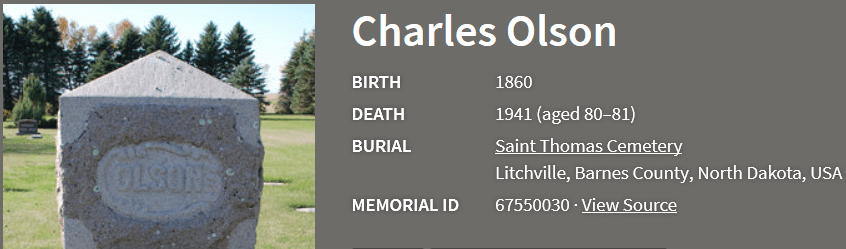
Charles Olson b 1860 – 1941 Saint Thomas Cemetery Litchville, Barnes
From his grave we learn when he was born
When he died
Where he is buried
and perhaps an obituary
sometimes the submitter is a relative
spouse and children (if they are on findagrave)
Turns out there are some records that can be found. Good luck with your farmer research! (ps fill out your 2020 census carefully – someone will be looking for you!)
 Geneographer