A Day in the Life at the Lamoni Children’s Home
“It was a momentous thing, the adopting of a new father and mother at the Home”! This 1915 Saints’ Herald report gave us a good idea what a Day in the Life was like for the children with the arrival of Brother & Sister Briggs as the 2nd Managers of the Home.
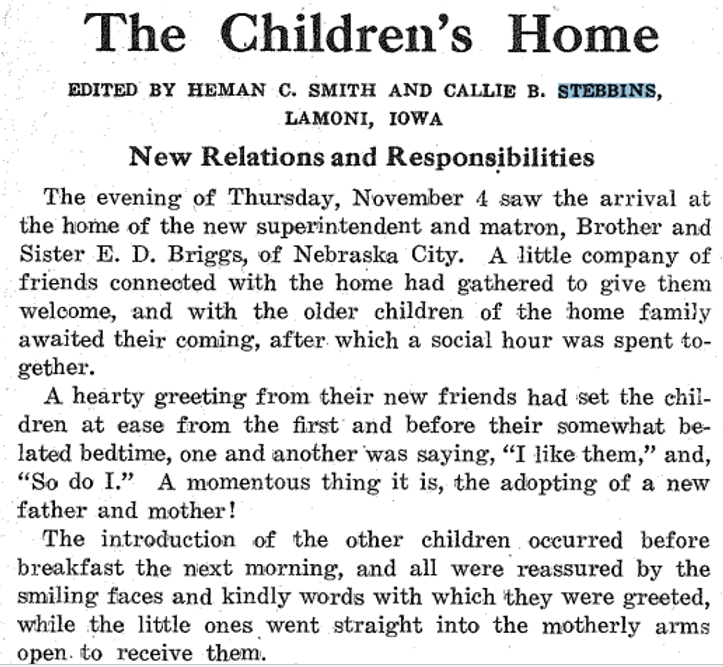

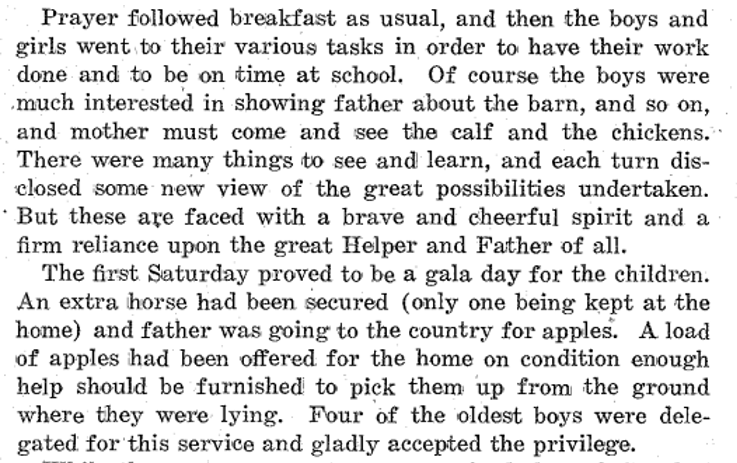

Early day descriptions of the Manager and Matron of the Children’s Home (W.P. and Isabelle Robinson) reflect that it was a loving, warm and kind place. But later reports indicate the reality was a less pleasant, more regimented daily life. Perhaps as the Home filled to capacity there were more chores, school work and attendance was required at required religious services.
Day to day life for the girls likely included washing dishes and sweeping. The boys did farm chores and hauled wood. Likely all children helped with the gardening. There were many references to proper discipline in all activities. This 1915 decision about the Home made it very clear they were rearing the children under the influence of the Reorganized Church of Jesus Christ of Latter Day Saints:

In the 1920’s the Home had about 30-40 children at one time. For a Home this size there was much laundry to be done, food to prepare and socks to be darned. Bushels of vegetables were grown in the gardens and cows to be fed and milked. There were eggs to be gathered, butter to be churned and meals to prepare.
The February 12, 1925 Lamoni Chronicle reported that “two young girls at the Children’s Home. Margaret Finn and Opal Williams started on foot for Kansas City. They were brought back by Mr. A.J. Yarrington. The girls were good and tired as a result of their thirty mile hike. Children cared for in a splendid institution such as we have in our midst are too young to correctly evaluate their opportunities, but as they grow older they will learn to more fully appreciate what is done for them and the advantages in a way of a home, schooling, etc, which is offered them.” [12 Feb 1925 Lamoni Chronicle, (Lamoni, Iowa), Thursday, p. 1]

Often the Saints’ Herald and Zion’s Ensign reported the ages and sizes of children at the Home so that members could sew clothing for them.
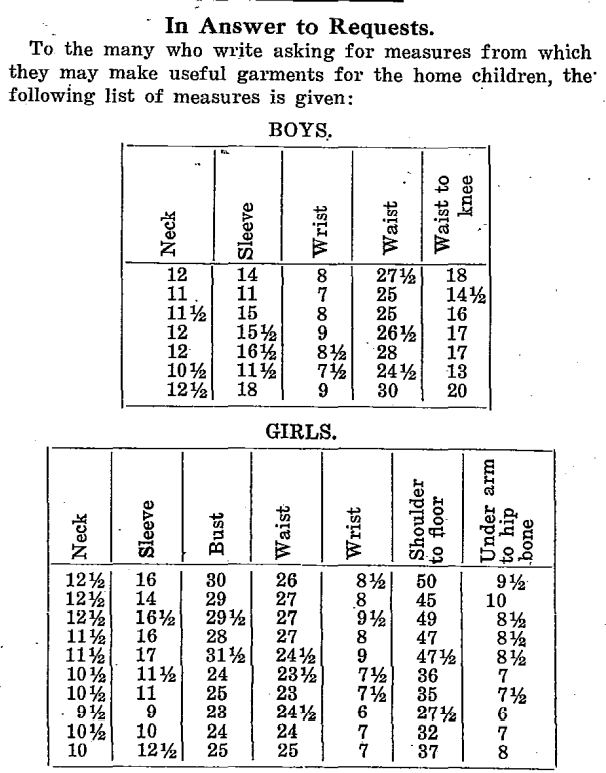
The list contains 7 boys and 10 girls. [The Saints’ Herald, 6 Dec 1911, p 1168]
Appreciation for donations was posted in the publications by name such as this 1913 report. Noting donations of everything from clothes to candy.

[The Saints’ Herald, March 26, 1913 p. 313]
From the 1915 Home photo it does look like the children were dressed nicely and the girls each had their own doll, likely made and donated by rLDS church members. Much support came from local churches all over the U.S. and Canada. Each monthly magazine included appreciation for the donations of money and items. Everything from caps, gloves, dresses, sweaters, cotton stockings, neckties and quilts. One of the donations was from Cecil Hays Rounds who sent “$2.25 for shoes for brother” That brother was Robert Hays who lived at the Lamoni Children’s Home from 1911-1915.
The Reorganized Latter Day Saints were a close-knit church family. Celebrating religious services and regional camp meeting gatherings. It appears the Home children were required to attend services at the nearby church. Records indicate the children were baptized at the Home, if they had not previously done so. I found these baptisms:
Murray, Florence Nov 15, 1913
Perry, Robert E. Lee Jun 14, 1914
Perry, James Jun 14, 1914
Perry, William Jun 14, 1914
McCormich, Edward May 12, 1918
Pendergraft, Floyd Mar 2, 1919
Bucy, Harold Newton Mar 2, 1919
Pendergraft, Hyla Oral Jul 3, 1920
Underwood, Gerald Jul 3, 1920
Bucy, Herman Wesley Jul 3, 1920
Howe, Dorothy Helen Jul 3, 1920
Kennedy, Opal Beulah Jul 3, 1920
Schambach, George Jun 26, 1921
Braby, Eva July 2, 1925
Howard, George July 2, 1925
Howard, Loren July 2, 1925
The Lamoni Chronicle newspaper reported the baptisms including 3 of the inmates of the Home George and Loren Howard, Dorothy Turpin.

Children’s Home residents likely attended the Central Lamoni School. In the 1920’s they attended the East Side School, sometimes the West Side School. I hope to discover more about the school situation.
In the early days of the Home, children likely arrived by train as the roads were not yet paved and few had access to cars. This is a picture of the lonely Lamoni train station (established 1910) where the children may have arrived and departed.
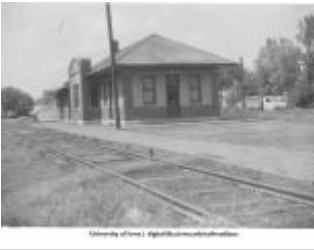
There were 4 passenger trains daily on the CB&Q. 17 Aug 1911 The Lamoni Chronicle (Lamoni, IA) p1
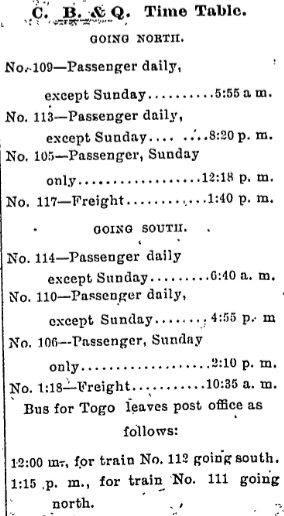
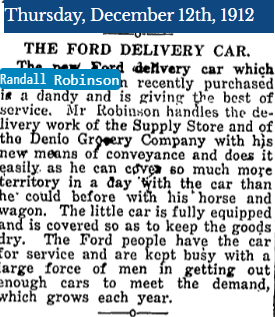
Times were changing rapidly and as the automobile gained popularity the train schedule became less and less useful. By 1913 there were several cars in Lamoni including W.A. Grenawalt. Randall Robinson also owned a car as noted in the newspaper. (Randall is the son of Superintendent Robinson.)

Recently I emailed with a woman whose mother was a child in the Home in the 1920s. She described a dismal situation. According to her there was limited food, hard work and hard discipline. She stated “they were required to attend church and other religious meetings. The discipline was so severe they left the home and the church too.”
I’ll end with some positive thoughts, hoping that sometimes the children had fun, I imagine they played hide and seek in the big yard, slid down the banister and jumped rope. I bet the boys would tease the girls and climbed trees maybe even sneaking food from the kitchen. There were 4th of July picnics, the county fair, Christmas celebrations and Easter egg hunts.
A 1925 report to the General Conference on the Children’s Home:

This research all started because I wanted to learn more about my own family’s heritage and it has turned into an effort to learn all I can about ALL the children at the Home in Lamoni. This Home was not necessarily an orphanage, often one of their parents were living but could not care for them. Many children arrived as “temporary care” although some were adopted.
Recently I stumbled onto the podcast regarding the Lutheran Home at Muscatine, Iowa. https://thehomes.buzzsprout.com/1847793 Produced by Andrew Newell and Karen Thalacker their day to day accounts of life at their children’s home is wonderful. As I listened to the podcast “The Homes” I was touched by their introduction describing “ordinary folks doing extraordinary things.”
In 1929 their Superintendent Rev. Kline wrote “When we are gone and forgotten our buildings will keep on proclaiming that here have lived people who had a heart for the needs of children.” Their podcast skillfully depicts that even though the buildings are gone, they have uncovered the long forgotten stories of the people who lived there, worked there and died there. They were at the same time ordinary and extraordinary. The Muscatine Home used the word “half-orphans” – meaning they might have had one parent, but they were unable to care for them. In the early days, there were no government programs to help and the churches did their best to provided help to families before Federal Programs took over.
Often the children left the Lamoni Home with nothing but their memories but sometimes they left with adoptive families who filled their life with love. For most they left and never looked back.
 Geneographer
Itâsâ a fine story! Keep up the good work. Your pal in East Selah.
LikeLike